

Actual info

ARTVERONA 2026
My work will be presented at ArtVerona, Italy, by Paci Contemporary, BOOTH F8-G9 PAV.12,
Preview Friday 9 October from 11am to 2pm, Public opening 9 October from 2pm to 9pm

Fotofestival Blatná 2026
The 21st annual Blatná Photography Festival (Czech republic) will feature my photographic work in a solo exhibition from September 19 to November 10, 2026. On that occasion, I will also give a lecture on my work on Sunday, September 20.
https://www.fotofestival.cz/

DOX gallery Prague, ANDROS
I was invited to participate in a project organized by the DOX Gallery and Center for Contemporary Art. The opening of the exhibition "ANDROS—The Male Body in Contemporary Central European Art" will take place on September 3, 2026 (DOX, Poupětova 1, Prague 7).

BETWEEN THE BODY AND ILLUSION
My work is presented in JSP gallery Prague in the project "BETWEEN THE BODY AND ILLUSION" from 12. 08 2026. Other participated artists: Jan Gemrot, Francesca Genovese, Alfio Giurato, Matouš Háša, Kristína Mésároš, Miguel Angel Moya, Ivan Pinkava, Rony Plesl, Miro Polach, Michael Rittstein, Richard Štipl, curator J.S. Pastuszak, JSP Gallery, Lázeňská 4, Praha

MIA photo fair Milano 2026
Michal Macku, Bert Stern, Sandy Skoglund, Erwin Olaf, Leslie Krims with Paci Contemporary, Italy
Milano Superstudio Piú, via Tortona 27, 18-22 March 2026

LILLE ART UP
The French museum "Musverre" will also present glass sculptures by Michal Macků, which it purchased for its representative collection at the Contemporary Art Fair "Lille Art Up". Lille Grand Palais, March 12-15, 2026

ARTEFIERA BOLOGNA 2026
My glass work will be presented by Paci contemporary gallery at Artefiera Bologna, 6-8 February, STAND B 88 | Pad. 25

Art Verona 2025
Galerie Paci Contemporary presents Michal Macku work at Art Verona, 10-12.October 2023, Veronafiere - Verona, PAV 12 - BOOTH F8 G9

Museo Arte en Vidrio de Alcorcón, Madrid
I have the honor of being one of the artists featured in the exhibition "Glass Soul: Existencia" at the Museo Arte en Vidrio de Alcorón, Madrid, Spain, 02.10.2025 – 30.11.2025

MusVerre Museum, France
I was invited to participate in the project "Á corps" ("To body") of the MusVerre State Museum and Art Glass Collection. The exhibition starts on February 21, 2025 and will continue all year until January 2026.

ARTEFIERA BOLOGNA 2024
Galeria Paci Contemporary presents Michal´s work at Arte Fiera Bologna, Feb 7/9 2025

JSP Art Gallery, Prague
Michal Macku - (IL)LUSIO, Solo exhibition, Gellages, Carbon prints and Glass objects in JSP Art Gallery Prague, Curatored by Jaroslaw Sebastian Pastuszak, 16.10 - 13.12.2024

Wie-ling Gallery, Kuala Lumpur, 2024
Michal Macku - Glass objects, solo exhibition in Weil-ling Gallery 14.9.2024 - 12.10.2024

Aipad Show New York 2024
Paci Contemporary presents Michal´s glass gellages and gellages at Aipad Show New York, April 25 - 28, 2024, 643 Park Ave, New York, NY 10065

MIART MILANO 2024
Galleria PaciArte Contemporanea presents Michal Macku´s work at "Miart Milano", 11 - 14 APRIL 2024 ALLIANZ MiCo MILANO

ARTEFIERA BOLOGNA 2024
Galeria Paci Contemporary presents Michal´s work at Arte Fiera Bologna, Feb 1/5 2024

Art Verona 2023
Galerie Paci Contemporary presents Michal Macku work at Art Verona, 13-15.October 2023

Aipad Show New York 2023
Paci Contemporary presents Michal´s glass gellages and gellages at Aipad Show New York March 30 - April 2nd, stand 213
ART VERONA 2021
Paci Contemporary presents Michal´s glass objects and gellages at Art Verona artfair, 15/17 October, 2021

CZECH GLASS, QUO VADIS!?
Art Lines organizes a group exhibition of Czech glass artists in GAD - Giudecca Art District, Venezia, Italy 3.9.2021 - 3.10.2021, Glass veek Venezia

GLASS SACRED GEOMETRIES
WEI LING CONTEMPORARY (The Gardrens Mall Lingkaran Syed Putra, Kuala Lumpur, Malaysia) presents Michal Macku´s Glass objects, 20.11 - 31.12.2020

PHOTO LONDON 2019
Galerie Paci Contemporary presents Michal Macku work at Photo London, Somerset House, London 16.05.2019 – 19.05.2019, STAND G02 – PAVILLON

FOTOGRAFICKÁ GALERIE FIDUCIA
Fotogalerie Fiducia Ostrava - Michal Macků, geláže, práce z let 1989-2005 14.6.2018 - 31.7.2018 FGF, Nádražní 30, Ostrava, Po-Pá 10.00-18.00
PHOTO LONDON 2018
Galerie Paci Contemporary presents Michal Macku work at Photo London, Somerset House, London 17-20 May 2018

ARTE FIERA BOLOGNA
Galeria Paci Contemporary presents Michal´s work at Arte Fiera Bologna, Feb 2/5 2016

ROTER KUNSTSALON
Karin Weber Gallery, Berlin, exhhibits Michal Macku´s glass objects at "Roter Kunstsalon", Museum Villa Rot, Germany, from 12th to 15th October 2017 www.villa-rot.de/

PORTO CERVO GALLERY
Paci Arte Contemporary presents Michal´s work in its gallery in Porto Cervo, Sardinia, from July 25th until September
PHOTO LONDON 2017
Galerie Paci Contemporary presents Michal Macku solo show at Photo London, 18 - 21 May 2017

AIPAD NEW YORK
Galerie Paci Contemporary presents Michal´s Glass Gellages at the AIPAD Photography Show, March 30 - April 2, 2017, Pier 94 New York City

SOLO SHOW IN GALERIE ZET
Galerie Zet prezents Michal Macku´s new glass works from November 26th 2016 More on: http://www.galeriezet.cz

PARIS PHOTO LOS ANGELES
Galeria Paci Contemporary presents Michal´s works at Paris Photo, 29. April - 1. May 2016, Paramount Pictures Studios, Los Angeles

AIPAD NEW YORK
Galeria Paci Contemporary presents Michal´s works at The Photography Show presented by AIPAD in New York, April 14-17, 2016

ART KARLSRUHE
In focus Galerie presents Michal´s works at The Karlsruhe Art Fair, 18th - 21st February 2016

THE MAMMOTH´S REFLEX
The Mammoth´s Reflex magazine published an article: Speciale Arte Fiera. Michal Macku e le sperimentazioni in camera oscura ( http://www.themammothreflex.com/report/2016/02/01/michal-macku-arte-fiera/ )

ART STAGE SINGAPORE 2016
Wei-ling Gallery, Kuala Lumpur, presents Michal Macku´s Glass Gellages at the Art Stage Singapore, Jan 21st - 24th, 2016

ARTEFIERA BOLOGNA 2016
Galeria Paci Contemporary presents Michal´s work at Arte Fiera Bologna, Jan.28th - Feb 1st. 2016

"LOVE IS..."
Michal participates with his Glass Gellage object at the exhibition "Love is..." In Focus Galeria, Koln, Germany The show runs 25.October - 22. December 2015

ART VERONA 2015
Paci Contemporary presents Michal´s glass objects and gellages at Art Verona artfair, 16/19 October, 2015

AFFORDABLE ART FAIR HONG KONG
Karin Weber Gallery presents Michal Macku´s work at Affordable Art Fair Hong Kong, 22-24 May 2015

ART15 LONDON´S GLOBAL ART FAIR
Gallery Paci Contemporary presents Michal´s work at Art 15 - London, 20-23 May 2015
PARIS PHOTO LOS ANGELES
Gallery Paci Contemporary presents solo show of Michal´s work at Paris Photo Los Angeles, 30 April - 3 May 2015

AIPAD NEW YORK
Gallery Paci Contemporary presents Michal´s work at New York AIPAD, April 16-19, 2015

Karin Weber Gallery Hong Kong
Exhibition of Michal Macku and Angela Glajcar in Karin Weber gallery, 20 Aberdeen Street Central, Hong Kong, www.karinwebergallery.com Opening 9 April 2015
ARTE FIERA BOLOGNA 2015
Galeria Paci Contemporary presents Michal´s work at Arte Fiera Bologna, Jan.23rd - 26th. 2015

PULSE MIAMI BEACH 2014
Galeria Paci Contemporary presents Michal´s work at artfair Pulse Miami Beach, Dec.4th - 7th. 2014

META - ILLUSIONI
Michal participates on exhibition of 5 artists named Meta-Illusioni: il giardino dell´impossibile in Napoli, Villa di Donato, Nov.27 2014 - Jan.10th, 2015.(www.art1307.com)

ART VERONA 2014
Galeria Paci Contemporary presents Michal´s work at Art Verona 2014, Oct.9th - 13t.2014

ZÁŘIVÝ KRYSTAL
Zářivý krystal - Bohumil Kubišta a české umění 1905 - 2013, Galerie výtvarného umění v Ostravě, 3.10.2014 - 4.1.2015

THE WALL STREET JOURNAL
THE WALL STREET JOURNAL, Sat-Sun April 12-13, 2014 published and aricle "One artist uses building dust to alter his prints" by Anna Russell - also about Macku´s works.

AFFORDABLE ART FAIR HONG KONG
Karin Weber Gallery Hong Kong presents Michal Macku´s work at Affordable Art Fair Hong Kong, 21 - 23 March 2014

Michal Macků - Gelages, verres, carbones
Czech Centre in Paris together with Galerie David Guiraud Paris present exhibition "Michal Macků - Gelages, verres, carbones" from 6th March to 4th April 2014. more

THE HONOLULU MUSEUM OF ART
Macku´s work is a part of project: Decisive Moments: Photographs from the Collection of Cherye R. and James F. Pierce. Dec 18th, 2013 - June 8, 2014
AIPAD SHOW 2014, NEW YORK
Gallery Paci contemporary presents Michal Macku´s work at Aipad Show, New York, 9-13 April 2014

PHOTO MARKET STOCKHOLM 2014
Gallery Paci contemporary presents Michal Macku´s work at Photo Market at Fotografiska Museum (Stockholm, Sweden), 4-6 April 2014

ART14 LONDON
Gallery Paci contemporary presents Michal Macku´s work at Art14 London, London, 27 Feb – 2 March, 2014
ARTE FIERA BOLOGNA 2014
Gallery Paci contemporary presents Michal Macku´s work at Arte Fiera Bologna, Bologna (Italy), 24-27 January 2014

PULSE MIAMI 2013
Gallery Paci contemporary presents Michal Macku´s work at Pulse Miami, Miami (USA), 5-8 December 2013
MICHAL MACKU – THE 3D PHOTOGRAPHY
Solo show of new glass work in Paci Contemporary Gallery, Via Trieste 48, Brescia, Italy, www.pacicontemporary.com, 5th October – 10th December 2013
PHOTO MARKET STOCKHOLM 2013
Gallery Paci contemporary presents Michal Macku´s work at Photo Market at Fotografiska Museum (Stockholm, Sweden) 14/17 Feb. 2013
ARTE FIERA BOLOGNA 2013
Gallery Paci contemporary presents Michal Macku´s work at Arte Fiera, Bologna (Italy) 25/28 January 2013
WEI-LING GALLERY
Wei-Ling Gallery, Kuala-Lumpur, Malaysia (www.weiling-gallery.com) presents new Glass Gellages at Michal Macku´s show from 16th November - 17th December 2012.

ART VERONA 2012
Gallery Paci contemporary presents Michal Macku´s work at Art Fair ART VERONA, Verona, Italy, 18-22 October, 2012.

FOTOFEVER BRUSSELS
Galleria PaciArte Contemporanea presents Michal Macku´s work at Fotofever Brussells, 4-7.Oct 2012.

THE ROAD TO CONTEMPORARY ART
Gallery Paci contemporary presents Michal Macku´s work at Art Fair THE ROAD TO CONTEMPORARY ART, Roma, Italy. May 25th - 27th, 2012.
MILAN IMAGE ART FAIR
Gallery Paci contemporary presents Michal Macku´s work at Art Fair MILAN IMAGE ART FAIR, Milan, Italy May 3rd - 6th, 2012.
ARTE FIERA BOLOGNA
Gallery Paci contemporary presents Michal Macku´s work at Art Fair ARTE FIERA BOLOGNA, Bologna, Italy January 27th - 30th, 2012.
SCOPE MIAMI 2011
Gallery Paci contemporary presents Michal Macku´s work at Art Fair SCOPE MIAMI, Miami, USA, November 29th - December 4th, 2011.
ART FAIR COLOGNE 2011
The In focus Gallery presents Michal Macku´s work at Art Fair Cologne, Cologne, Germany, October 29th - November 1st, 2011.
ART VERONA 2011
Gallery Paci contemporary presents Michal Macku´s work at Art Fair ART VERONA, Verona, Italy, October 6th - 10th, 2011.
KARIN WEBER GALLERY HONG KONG
Exhibition of Michal´s Glass gellages, gellages and carbon prints in Karin Weber gallery, 20 Aberdeen Street Central, Hong Kong, www.karinwebergallery.com, Opening 13.October 2011.
ROMA. THE ROAD TO CONTEMPORARY ART
Galleria PaciArte Contemporanea presents Michal Macku´s work at Roma, Palazzo Venezia, may 6th - 38h 2011.
ART CHICAGO
Galleria PaciArte Contemporanea presents Michal Macku´s work at "Art Chicago", April 29 - May 2011.
MIART MILANO
Galleria PaciArte Contemporanea presents Michal Macku´s work at "Miart Milano" fieramilanocity, Milano, April 8 - 11 2011.
SCOPE NEW YORK
Galleria PaciArte Contemporanea presents Michal Macku´s work at "Scope New York, March 2nd - 6th, 2011, Booth B21.
ART FIRST BOLOGNA
Galleria PaciArte Contemporanea presents Michal Macku´s work at "Arte Fiera Art First Bologna, Jan 28th - 31st, 2011.
ART STAGE SINGAPORE
Wei-ling Gallery, Kuala Lumpur, presents Michal Macku´s work at "Art Stage Singapore, Jan 12th - 16th, 2011.
SCOPE MIAMI
Galleria PaciArte Contemporanea presents Michal Macku´s work at Scope Miami from 30th Nowember to 5th December 2010.
ART VERONA
Galleria PaciArte Contemporanea presents Michal Macku´s work at "Modern and Contemporary Art Fair ART VERONA, October 14th - 18th, 2010
DARKNESS FOR LIGHT - CZECH PHOTOGRAPHY TODAY
Shiseido Gallery,7-5-5 Ginza, Chuo-ku, Tokyo, Japan, June 19th - August 8th, 2010. (Michal Macku, Dita Pepe, Ivan Pinkava, Rudo Prekop, Tono Stano, Jindrich Streit, Tereza Vlckova etc.)
SCOPE ART SHOW BASEL 10
Galleria PaciArte Contemporanea presents Michal Macku´s work at Scope Basel June 15th - 19th 2010, booth G10.
ROMA. THE ROAD TO CONTEMPORARY ART
Galleria PaciArte Contemporanea presents Michal Macku´s work at Roma, Palazzo Venezia, may 27th - 30th 2010, pad. 3 stand 62.
MIART MILANO
Galleria PaciArte Contemporanea presents Michal Macku´s work at "Miart Milano" fieramilanocity, Milano, pavilions 3 and 4, April 17 - 20 2010.
ARCO MADRID
Galleria PaciArte Contemporanea presents Michal Macku´s work at "Arco Madrid Art Fair, Feb 17th - 21th, 2010
ART FIRST BOLOGNA
Galleria PaciArte Contemporanea presents Michal Macku´s work at "Arte Fiera Art First Bologna, Jan 29th - 31st, 2010
GLASS GELLAGES
Galleria PaciArte Contemporanea at new address at Via Trieste 48, 25121 Brescia - Italy, www.paciarte.com - The exhibition will run from Jan 19th 2009 to Feb 23rd, 2010
PHOTO MIAMI
Galleria PaciArte Contemporanea presents project with Michal Macku, Sandy Skoglund and Clark & Pougnaud at Photo Miami from 1st to 6th December 2009
GIFTS FOR THE GIFTED
GV Art, London, 49 Chiltern Street (www.gvart.co.uk) presents group show "Gifts for the Gifted" from 26th November to 20th December 2009
ART VERONA
Galleria PaciArte Contemporanea presents Michal Macku´s work at "Modern and Contemporary Art Fair ART VERONA, September 17th - 20th, 2009
SCOPE ART SHOW BASEL 09
8-14 June 2009: Galleria Paci Arte Contemporanea presents Michal Macku.
ROMA. THE ROAD TO CONTEMPORARY ART
Roma, Palazzo Venezia, from 2nd do 5th April 2009: Galleria Paci Arte Contemporanea, Sandy Skoglund - Michal Macku.
WEI-LING GALLERY
Wei-Ling Gallery, Kuala-Lumpur, Malaysia (www.weiling-gallery.com) presents Gellages, Carbon prints and Glass Gellages at Michal Macku´s show from 6th April to 30th April 2009.
THERE IS A HOPE
GV Art, London, 49 Chiltern Street (www.gvart.co.uk) presents group show "There is a Hope" from 20th January to 17th March 2009 (Michal Macku, Rachel Gadsden, Dan Peyton etc.
PHOTO MIAMI
Galleria PaciArte Contemporanea presents project with Michal Macku and Sandy Skoglund at Photo Miami from 3rd to 7th December 2008
AAF AMSTERDAM
GV art Robert Devcic, London, presents Michal´s work at The Affordable Art Fair Amsterdam from October 30th till November 2nd 2008.
ART VERONA
Galleria PaciArte Contemporanea presents Michal Macku´s work at "Modern and Contemporary Art Fair ART VERONA from October 16th till October 20th, 2008
GALERIE V KAPLI
Galerie V Kapli in Bruntal, Czech Republic presents exhibition named Michal Macku - Glass Gellages. 7.10 - 5.11 2008. The show will be open by Jindrich Streit
GALERIE DAVID GUIRAUD
Gellages and Glass works in Galerie David Guiraud, 5, rue de Perche, Paris. (tel: +33 (0)1 42717862, dgphotographies@orange.fr). The exhibition will run from June 3rd to July 19th, 2008. The opening show: May 31
MIART MILANO
The Gallery PaciArte will be from 4th-7th April 2008 at MiArt Milano pad.4 post.N09 (Contemporaneo), Artist show: Bernard Faucon, Leslie Krims, Nicola Evangelisti, Michal Macku, Sandro Martini, Artur Tress, Paolo Conti, Paola Pansini.
BRIDGE ART FAIR NY
The Gallery PaciArte will be from 27th-30th March 2008 at Bridge Art fair New York booth 45. Artist show: Nicola Evangelisti, Michal Macku.
BRIDGE ART FAIR MIAMI
The Catalina Hotel - Miami 2007 6-9 December, Galleria PaciArte Room 118, http://www.bridgeartfair.com/,Artists: N. Evangelisti, M. Macku


🇬🇧 I was born in April 1963 in Bruntál, a small foothill town in the border region of what was then communist Czechoslovakia.
From 1978 to 1982, I attended the local high school, and from 1982 to 1986, I studied at the Brno University of Technical Sciences, Faculty of Technology. From 1987 to 1989, I attended the Institute of Art Photography in Prague.
I was involved in the birth of two children.
In 1992, I started working as a freelancer.
Since then, I’ve been enjoying life as best I can. I try not to betray myself too much and not to take myself too seriously. I’m increasingly amazed at how many surprises life brings me…
And I’m amazed and amazed—the further I go, the more
🇨🇿 Narodil jsem se v dubnu 1963 v Bruntále, malém podhorském městě v pohraničí tehdy komunistického Československa.
V letech 1978-1982 jsem absolvoval místní gymnázium, 1982-86 pak Vysoké učení technické v Brně, fakultu technologickou. V letech 1987-89 Institut výtvarné fotografie se sídlem v Praze.
Podílel jsem se na příchodu dvou dětí na svět.
Od roku 1992 jsem začal pracovat na „volné noze“. Od té doby si užívám života, jak to jde. Snažím se příliš se nezpronevěřit sám sobě a nebrat se příliš vážně. Stále více se divím, kolik překvapení mi život přináší…
A žasnu a žasnu, čím dále, tím více
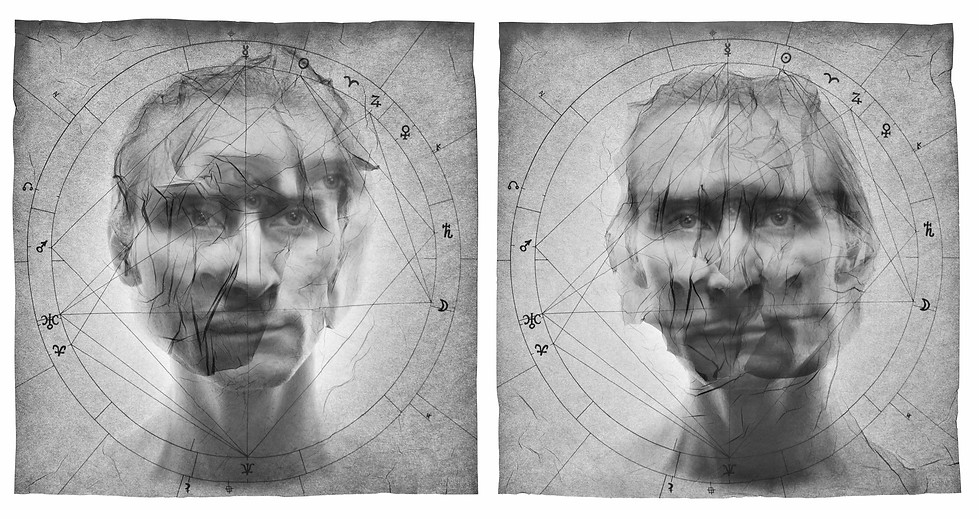
🇬🇧 Gellage
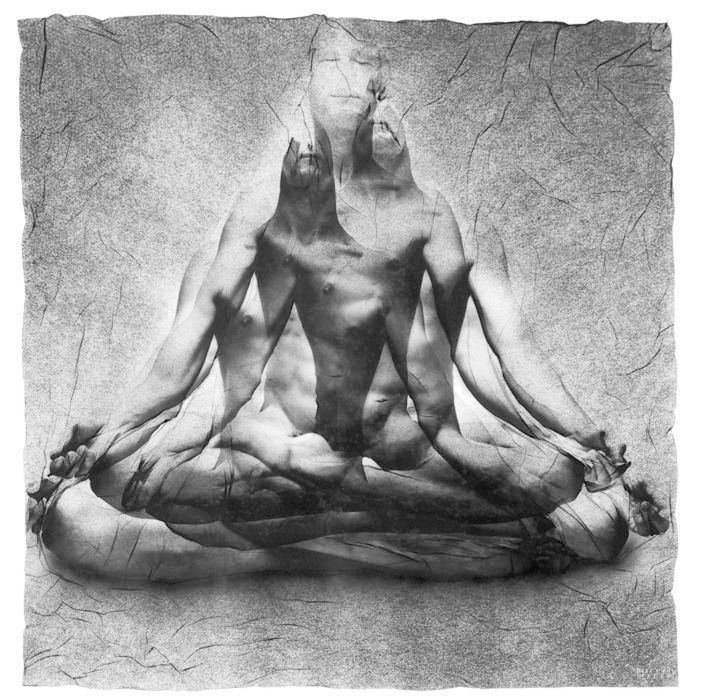
Since late 1989, I have been systematically using and developing my own creative technique, which I have named “Gellage” (a word combining “collage” and “gelatin”).
This technique involves transferring an exposed, developed, and fixed photographic emulsion from its original substrate (large-format film) onto paper. Once released, the emulsion behaves in an aqueous environment like a transparent and elastic gelatinous mass, allowing me to reshape and alter the original proportions of the image during the transfer to paper, change their mutual relationships, and imbue them with new meaning. After the composition is created and dried on the paper, a labor-intensive finishing process follows:
Using a scalpel, water, and brushes, it is necessary to remove excess emulsion, bubbles, and similar imperfections. Finally, the finished Gellage must be stretched on a frame, the composition may be enhanced with retouching using a brush and airbrush, and it is then fixed. The finished work is a compact image with a delicate surface texture. Each Gellage, created using high-quality baryta paper, is highly resistant to degradation because the paper itself is not exposed to the chemical action of photographic developer and fixer during the process. It is thus suitable for archiving and exhibition.
This demanding technology, which often involves using more than one negative per image, makes it impossible to create identical copies: each Gellage is an original work of art. I have established a practice of numbered editions, creating a maximum of 12 signed and numbered copies of each motif.
In my Gellages, I used the naked human body (mostly my own). Through the Gellage process, I abstracted and distorted this specific body. From the very beginning, this process fascinated me by transcending the traditional limits associated with analog photography.
I was constantly searching for new means of expression, and step by step I discovered almost unlimited possibilities through working with the relaxed gelatin emulsion. The photographic part of the process—the model, lighting, and the optical and chemical processes involved in creating the negative—represented for me a concrete connection with physical reality, captured in “real” time and in the “real” world. The subsequent processing of the image using the Gellage technique allowed me to take one of these captured and fixed moments of “reality,” extract a figure or human body from it, and thus subject it anew to the passage of time, transform it, or confront it with itself or with a new meaning in a new gesture. The magic of this process is similar to that of animated film, but it is not a trick. It was very important for me to incorporate and build upon the history of the captured image while simultaneously being aware of and in direct contact with the deliberate shaping of its new reality. In this work, I placed “images of bodies” into new situations, new contexts, new “realities,” which caused their original, “authentic” reality to become relative. I was often surprised myself by the new connections and meanings I discovered during the creative process. Naturally, I always started with a specific intention, but the result was often very different.
But around the year 2000, I began to feel more and more that I was gradually losing creative fulfillment and inner authenticity in my work with the Gellage technique. A certain strong expressiveness and stylization ceased to resonate with my further inner and spiritual development. I was searching for new paths in my work. At that time, I began to take an interest in and learn new techniques—using old large-format photographic techniques—platinotype and carbon pring… And gradually, in discovering the principles of sacred geometry…
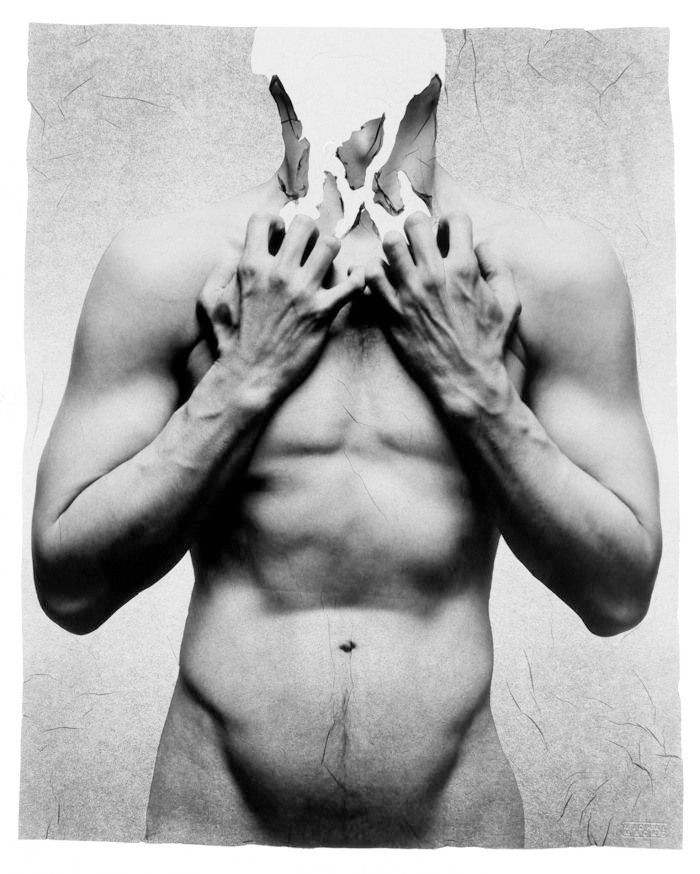
🇨🇿 Geláž
Od konce roku 1989 jsem začal systematicky používat a rozvíjet svou vlastní tvůrčí techniku, kterou jsem nazval „geláž“ (slovní spojení koláže a želatiny).
Tato technika spočívá v přenesení exponované, vyvolané a ustálené fotografické emulze z původního podkladu (velkoformátový film) na papír. Takto uvolněná emulze se chová ve vodním prostředí jako průhledná a elastická želatinová hmota a umožňuje během přenosu na papír přetvářet a měnit původní proporce obrazu, měnit jejich vzájemné vztahy a vtisknout jim nový význam. Po vytvoření a usušení kompozice na papíru následuje pracné dokončení: Pomocí skalpelu, vody a štětců je třeba odstranit nadbytečné části emulze, bubliny a podobně.
Nakonec je potřeba hotovou geláž vypnout na rámu, případně doplnit kompozici retušováním štětcem a airbrushem a nakonec zafixovat. Hotové dílo představuje kompaktní obraz s jemnou povrchovou strukturou. Každá geláž, vytvořená s použitím kvalitního barytovaného papíru, je velmi odolná proti degradaci, protože vlastní papír v procesu není vystaven chemickému působení fotografické vývojky a ustalovače. Hodí se tak pro archivování a vystavování.
Náročná technologie, která často zahrnuje použití více než jednoho negativu na jeden obraz, znemožňuje vytvoření identických kopií: Každá geláž je originálním uměleckým dílem. Stanovil jsem si praxi číslovaných edic, z každého motivu jsem vytvořil maximálně 12 podepsaných a číslovaných kopií.
Ve svých gelážích jsem používal nahé lidské tělo (většinou své vlastní). Prostřednictvím procesu geláže jsem toto konkrétní tělo abstrahoval a deformoval. Tento proces byl pro mě od prvního okamžiku fascinující překročením tradičních limitů spojovaných s analogovou fotografií.
Neustále jsem hledal nové prostředky vyjádření a krok za krokem jsem objevoval téměř neomezené možnosti prostřednictvím práce s uvolněnou želatinovou emulzí. Fotografická část procesu – model, svícení, optický a chemický proces při tvorbě negativu pro mě znamenaly konkrétní dotek s fyzickou realitou, zachycenou v „reálném“ čase a v „reálném“ světě. Následné zpracování obrazu technikou geláže mi umožnilo vzít jeden z těchto zachycených a zafixovaných momentů „reality“, uvolnit z něj postavu, lidské tělo, a tak ji zvovu podřídit plynutí času, zmožit ji či konfrontovat samu se sebou nebo s novým významem v novém gestu. Kouzlo tohoto procesu je podobné kouzlu animovaného filmu, ale nejde o trik. Bylo pro mě velmi důležité zahrnou a vycházet z historie zachyceného obrazu a zárověn si být vědom a v přímém kontaktu se záměrným utvářením jeho nové reality. V této práci jsem umisťoval „obrazy těl“ do nových situací, nových kontextů, nových „realit“, což způsobovalo, že se jejich původní, „autentická“ realita stala relativní. Často mě samotného překvapily nové souvislosti a významy, které jsem v průběhu tvorby nacházel. Přirozeně jsem vždy začínal s konkrétním záměrem, ale výsledek byl často velmi odlišný.
Ale přibližně po roce 2000 jsem začínal stále více pociťovat, že se ve své práci s technikou geláže postupně přestávám nacházet tvůrčí naplnění a vnitřní autentičnost. Jistá silná expresivita a stylizace přestávala souznít s mým dalším vnitřním a spirituální vývojem. Hledal jsem nové cesty ve své tvorbě. V tu dobu jsem se začal zajímat a učit se nové postupy – s využitím starých velkoformátových fotografických technik – platinotypie a uhlotisku… A postupně v objevování principů posvátné geometrie…
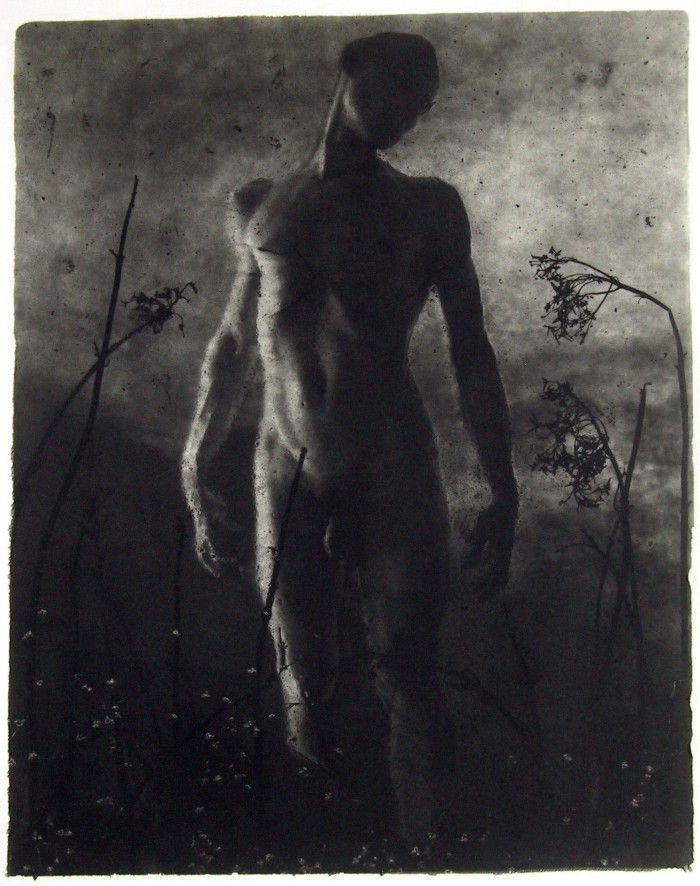
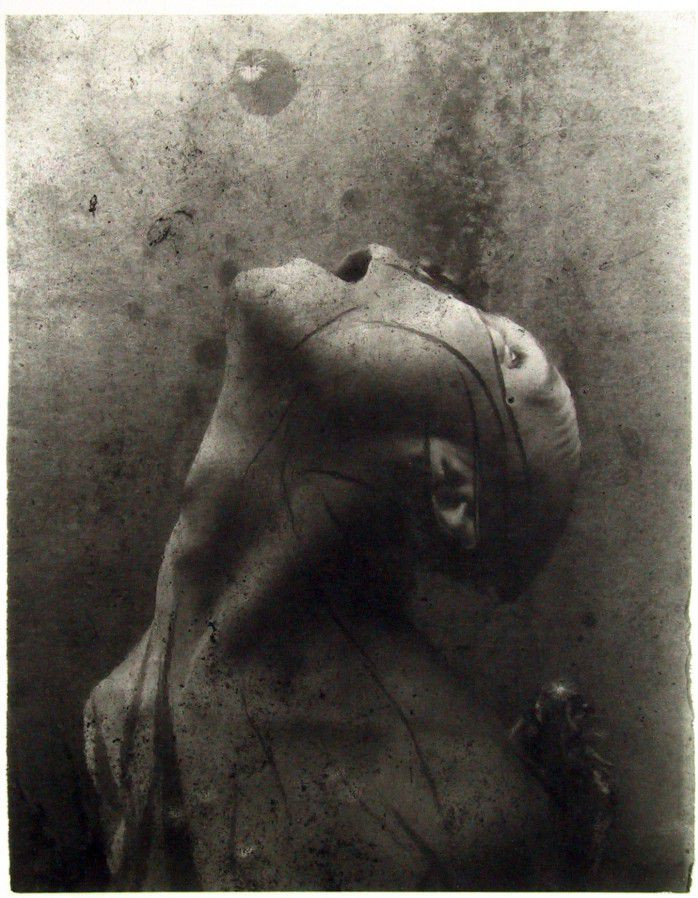
🇬🇧 Carbon print
Since 2000, in conjunction with the Gellage printing technique, I have also become interested in historical photographic techniques. I had previously been interested in so-called heliogravure, an intaglio technique originally used in printmaking to reproduce photographic images. During my exhibitions in New York, I encountered the technique of platinotype and other so-called fine art prints, and for a time I engaged with them in practice.
But it was only my encounter with the carbon print technique in the work of the famous Czech photographer František Drtikol that truly spoke to me. While studying the processes, I realized that this technique, based on the transfer of a gelatin layer onto paper, has much in common with my Gellage technique.
By a fortunate turn of events, I was offered the opportunity at that time to participate in the creation of an authorized portfolio of facsimiles of Drtikol’s most famous nudes from the 1930s, created precisely using the carbon print technique. During this work, I had access to the artist’s original glass negatives in my studio, as well as expert guidance from specialists at the Prague Museum of Decorative Arts. All of this was highly inspiring and motivating in helping me acquire practical skills and a certain mastery of this extremely difficult photographic technique.
The experience I gained led me to create a series of my own works using the carbon print technique. These works measure approximately 35 x 30 cm (14 x 12''), are printed on the highest quality watermarked art paper, stamped and signed, and the edition of each motif is limited to 24 numbered copies.
About the carbon print technique
(Text from the book: The Book of Carbon and Carbro: Contemporary Procedures for Monochrome Pigment Printmaking, Sandy King with John Lockhard, Hong Kong, 2019, ISBN 978-7-5514-2394-6)
In terms of versatility and range of possibilities, carbon printing is an excellent process. It is capable of producing images with a wide range of visual characteristics, virtually any color or tone, and on a wide variety of surfaces. Throughout its history, when it coexisted with other commercial processes in the second half of the 19th century, carbon printing was considered the aristocrat among printing processes. Carbon prints were more expensive than those produced by other processes, about twice as expensive as platinum prints and three to five times more expensive than silver prints. On the other hand, this technique is very difficult to master. However, once mastered, the carbon print process offers a range of possibilities not available in any other photographic system and which are difficult, if not impossible, to imitate.
Carbon printing, like all pigment processes, works by applying colloids (gelatin, gum arabic, egg white, casein, etc.) to a suitable substrate, sensitizing them with a dichromate salt, and activating them through exposure to UV light; the colloids then change their physical properties in proportion to the intensity of the chemical or light. This process, called tanning or curing, makes the colloid insoluble in hot water.
Large-format negatives (the negative is the same size as the resulting image) are used to expose carbon prints, which are then exposed to UV light or, using the traditional method, sunlight.
Carbon prints can be produced so that they are virtually indistinguishable from silver prints. Thanks to their distinct relief, carbon prints often have greater apparent sharpness than silver prints. The archival properties of carbon prints are superior to those of prints on papers containing silver salts. The stability of carbon is limited only by the gelatin support and the paper substrate, making it the most stable of all photographic processes.
🇨🇿 Uhlotisk
Od roku 2000 jsem se v kombinaci s technikou geláže začal také zajímat o historické fotografické techniky. Již dříve jsem se zajímal o tzv. heliogravuru, hlubotiskovou původně grafickou techniku používanou na přenos fotografického obrazu. Při svých výstavách v New Yorku jsem se setkal s technikou platinotypie a dalších tzv. ušlechtilých tisků a po určitou dobu jsem se jimi prakticky zabýval.
Ale teprve setkání s technikou uhlotisku v práci slavného českého fotografa Františka Drtikola mě opravdu zásadně oslovilo. Při studiu postupů jsem pochopil, že tato technika má v principu přenosu želatinové vrstvy na papír mnoho společného s mou technikou geláže.
Štastnou souhrou okolností mi byla v té době nabídnuta možnost podílet se na tvorbě autorizovaného portfolia faksimilií nejslavnějších Drtikolových aktů z 30tých let vytvořených právě technikou uhlotisku. Při této práci se mi dostaly do rukou a atelieru původní originální skleněné negativy autora a také konzultační vedení odborníků pražského umělecko-průmyslového muzea. To vše bylo velmi inspirující a motivující pro dosažení praktických dovedností a určitého mistrovství ve zvládnutí této extrémně obtížné fotografické techniky.
Nabytá praxe mě vedla k vytvoření série vlastních děl technikou uhlotisku. Tyto práce mají rozměry přibližně 35 x 30 cm (14 x 12''), jsou na grafickém papíru s vodoznakem nejvyšší kvality, opatřeny razítkem a podpisem a náklad každého motivu je limitován na 24 číslovaných exemplářů.
O technice uhlotisku
(Text z knihy: The Book of Carbon and Carbro: Contemporary Procedures for Monochrome Pigment Printmaking, Sandy King with John Lockhard, Hong Kong, 2019, ISBN 978-7-5514-2394-6)
Co se týče univerzálnosti a šířky možností, je uhlotisk vynikající proces. Je schopen prezentovat obrazy s širokou škálou obrazových charakteristik, prakticky jakékoli barvy nebo tónu a na široké škále povrchů. Během celé své historie, kdy v druhé polovině 19. století koexistoval s jinými komerčními procesy, byl uhlotisk považován za aristokrata mezi tiskovými procesy. Uhlotisky byly nákladnější než ty vyrobené jinými procesy, asi dvakrát dražší než platinové a třikrát až pětkrát dražší než stříbrné. Na druhou stranu je tato technika velmi obtížná na zpracování. Jakmile ji však člověk zvládne, nabízí proces uhlotisku řadu možností, které nejsou k dispozici u žádného jiného fotografického systému a které je obtížné, ne-li nemožné, napodobit.
Uhlotisk, stejně jako všechny pigmentové procesy, spočívá v tom, že koloidy (želatina, arabská guma, vaječný bílek, kasein atd.), jsou-li naneseny na vhodný podklad, senzitivované dichromátovou solí a aktivovány expozicí UV světla, mění své fyzikální vlastnosti úměrně intenzitě chemické látky nebo světla. Tento proces, nazývaný taninování nebo vytvrzování, činí koloid nerozpustným v horké vodě.
Pro exponování uhlotisků se používá velkoformátový negativ (negativ je stejně velký jako výsledný obraz) a exponuje se UV světlem, nebo tradičním postupem slunečním světlem).
Uhlotisky lze vyrobit tak, aby byly prakticky k nerozeznání od stříbrných tisků. Díky svému zřetelnému reliéfu mají uhlotiskové obrazy často větší zdánlivou ostrost než stříbrné tisky. Archivační vlastnosti uhlíkových tisků jsou lepší než u tisků na papírech se stříbrnými solemi. Stabilita uhlíku je omezena pouze želatinovým nosičem a papírovým podkladem, což z něj činí nejstabilnější ze všech fotografických procesů.
🇬🇧 Glass objects
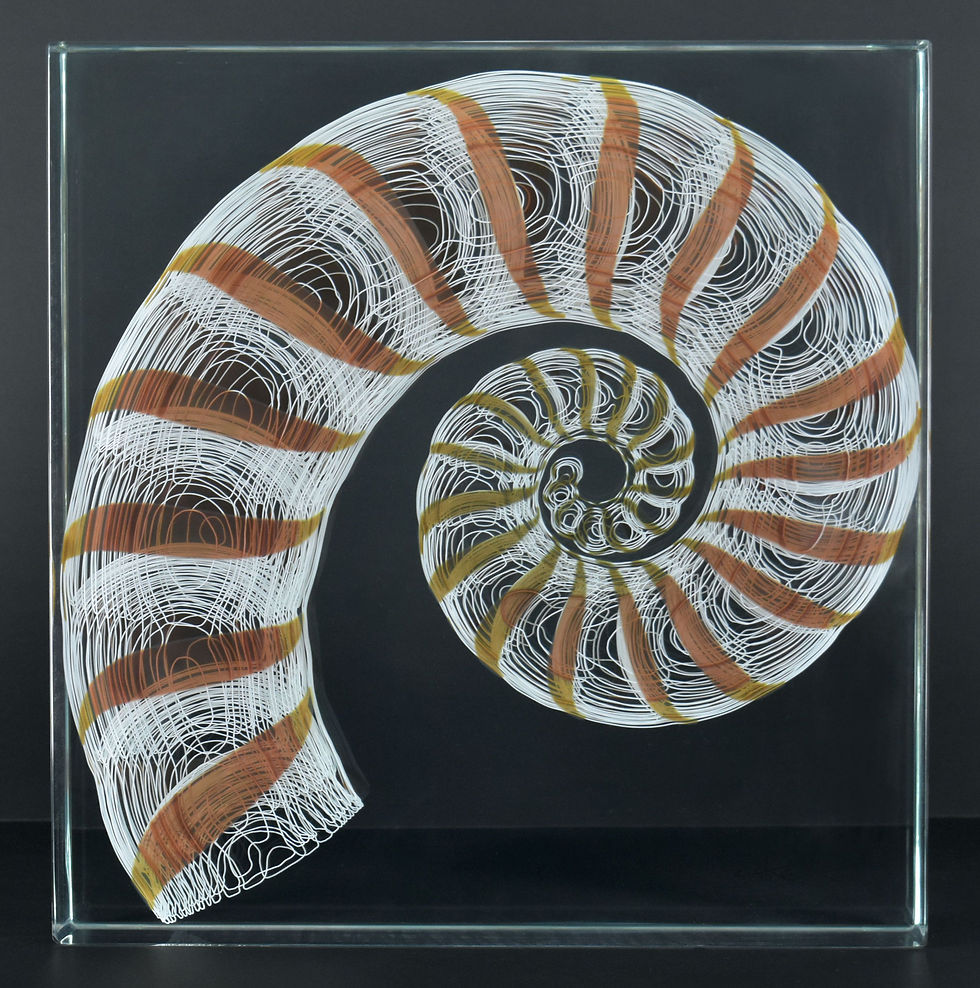
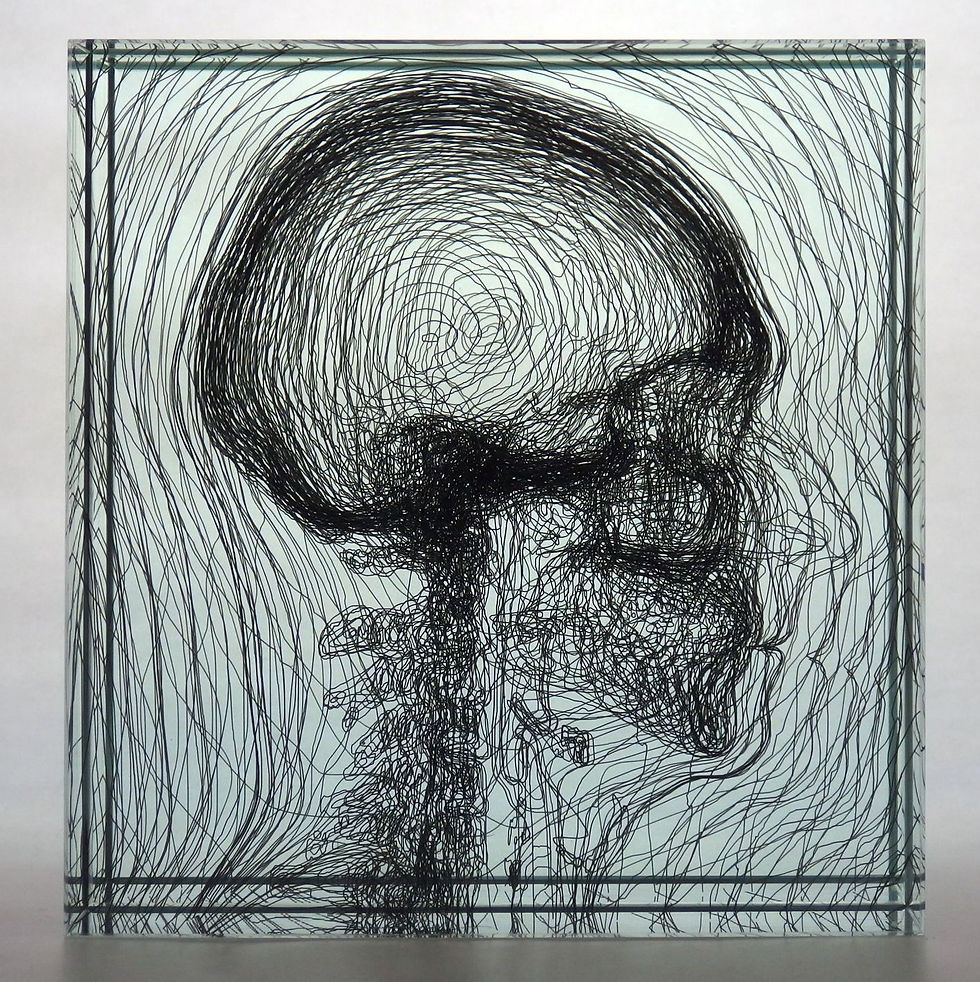
Around 2005, I began developing my new works using glass. The initial phase was characterized by the use of my previous techniques—Gellage and carbon pring—to achieve three-dimensional visual compositions within a block of glass. I referred to these objects as “glass Gellages". Around 2010, I began using additional technical and technological methods to create 3D images in glass objects, such as computed tomography for my series of “absolute self-portraits,” or mechanical processing and scanning followed by digital processing of templates, and more recently, 3D modeling and 3D scanning.
Glass objects are neither photographs in the traditional sense nor sculptures. They exist at the intersection of photography, glass art, and object installation. Each work consists of several precisely crafted layers of glass into which a photographic or otherwise created image is transferred and physically incorporated.
The image is not merely printed on the surface but becomes an integral structural component of the glass object itself.
The process involves a complex combination of analog and digital steps. Original photographic negatives or digitally prepared images are converted into large-format, high-resolution prints, which are then subjected to demanding manual processing. Historical photographic principles—working with light, emulsion, and the depth of the material—are combined with contemporary imaging technologies and advanced glass manufacturing methods. Each phase requires absolute precision; even minimal deviations can irreversibly alter the resulting object.
Unlike flat photographic prints, glass Gellages possess true spatial depth. The image unfolds in layers and responds to light, viewing angle, and the surrounding space. This physical depth creates a dynamic visual experience: parts of the image seem to float, recede, or emerge depending on how the viewer moves around the object. Photography thus becomes an optical and material experience rather than a static surface representation.
From an archival perspective, glass objects represent an exceptionally stable form of photographic expression. As a medium, glass offers long-term durability that far exceeds that of traditional photographic papers. Combined with a pigment print and the absence of chemically unstable silver compounds, the works are designed for a long lifespan suitable for museum collections and private archives.
Each glass object is produced as an original work of art or in a strictly limited edition. Due to the complexity of the process and the handmade nature of the production, no two objects are completely identical. Variations in glass structure, light refraction, and internal layering are inherent to this technique and form an essential part of each piece’s character.
🇨🇿 Skleněné objekty
Přibližně od roku 2005 jsem začal rozvíjet své nové práce s využitím skla. První období bylo charakteristické využitím mých předchozích postupů, geláže a uhlotisku k dosažení třírozměrných obrazových kompozic v bloku skla. Tyto objekty jsem nazýval „skleněné geláže“. Přibližně od roku 2010 jsem k vytvoření 3D obrazu ve skleněných objektech začal využívat i další technické a technologické možnosti, například počítačovou tomografii pro sérii svých „absolutních autoportrétů“, nebo mechanického zpracování a skenování a posléze digitálního zpracování předloh či v poslední době také 3D modelování či 3D skenování.
Skleněné objekty nejsou fotografiemi v tradičním smyslu, ani sochami. Nacházejí se na pomezí fotografie, sklářského umění a objektové instalace. Každé dílo se skládá z několika precizně zpracovaných skleněných vrstev, do nichž je fotografický nebo jinak vytvořený obraz přenesen a fyzicky zakomponován.
Obraz není pouze vytištěn na povrchu, ale stává se integrální strukturální součástí samotného skleněného objektu.
Proces zahrnuje komplexní kombinaci analogových a digitálních kroků. Originální fotografické negativy nebo digitálně připravené obrazy jsou převedeny do velkoformátových výstupů s vysokým rozlišením, které jsou poté podrobeny náročnému ručnímu zpracování. Historické fotografické principy – práce se světlem, emulzí a hloubkou materiálu – se spojují se současnými zobrazovacími technologiemi a pokročilými metodami výroby skla. Každá fáze vyžaduje absolutní přesnost; i minimální odchylky mohou nezvratně změnit výsledný objekt.
Na rozdíl od plochých fotografických tisků mají skleněné geláže skutečnou prostorovou hloubku. Obraz se odvíjí ve vrstvách a reaguje na světlo, úhel pohledu a okolní prostor. Tato fyzická hloubka vytváří proměnlivý vizuální zážitek: části obrazu se zdají vznášet, ustupovat nebo vynořovat v závislosti na tom, jak se divák pohybuje kolem objektu. Fotografie se tak stává optickým a materiálním zážitkem spíše než pevným povrchovým zobrazením.
Z archivačního hlediska představují skleněné objekty mimořádně stabilní formu fotografického vyjádření. Sklo jako nosič nabízí dlouhodobou trvanlivost, která daleko přesahuje trvanlivost tradičních fotografických papírů. V kombinaci s pigmentovým obrazem a absencí chemicky nestabilních sloučenin stříbra jsou díla navržena pro dlouhou životnost vhodnou pro muzejní sbírky a soukromé archivy.
Každý skleněný objekt je vyroben jako originální umělecké dílo nebo v přísně limitované edici. Vzhledem ke složitosti procesu a ruční povaze výroby nejsou žádné dva objekty zcela identické. Variace ve struktuře skla, lomu světla a vnitřním vrstvení jsou vlastní této technice a tvoří podstatnou část charakteru každého kusu.
Exhibitions
Solo exhibitions
1990
Robert Koch Gallery, San Francisco
Kulturní dům, Bruntál, Czechoslovakia
Galerie Centrum, Plzeň, Czechoslovakia
1991
Galerie pod podloubím, Olomouc, Czechoslovakia
Fotografisk Galleri, Copenhagen
1992
Galerie Bílá růže, Prague
Galerie Caesar, Olomouc, Czechoslovakia
Galerie Mladých, Brno, Czechoslovakia
Umělecká průmyslovka, Palisády, Bratislava, Czechoslovakia
1993
Galerie Aura, Olomouc, Czech Republic
1994
Prague House of Photography, Prague
Galerie Ambrosiana, Brno, Czech Republic
1995
Photogalerie Bild, Aarau, Switzerland
1996
Victor Barsokevitsch-Valokuvakeskus, Kuopio, Finland
Gallery St. Gervais, Geneva
Slezské muzeum, Opava, Czech Republic
Galleri Karneval, Albrunna, Sweden
Photoforum Feldeg, Zurich
Photography Gallery, Perth, Australia
1998
Galerie „U Řečických“, Prague
1999
In focus Galerie am Dom, Köln, Germany
Galerie Pennings, Eindhoven, The Netherlands
2000
John Stevenson Gallery, New York
2001
FotoGaleria Teatro San Martin, Buenos Aires
Estudio Lisenberg, Buenos Aires
2002
Galeria Omar Alonzo, Puerto Vallarta, Mexico
2004
Dylan Thomas Centre, Swansea, UK
Aberystwyth Art College, Aberystwyth, UK
John Stevenson Gallery, New York
In focus Galerie am Dom, Köln, Germany
J&T Bank, Prague, Czech Republic
2005
Galerie Brno, Brno, Czech Republic
Gallery „pf“, Poznań, Poland
Galerie Palais Breuner, Vienna, Austria
Městské divadlo Zlín, Czech Republic
Státní zámek Třeboň, Czech Republic
Czech Centre, Munich, Germany
2006
Galerie Art Affair, Regensburg, Germany
Photo Event, Turnhout, Belgium
Ottoman Mint Complex (IFSAK), Istanbul, Turkey
2007
Galerie Caesar, Olomouc, Czech Republic
Gallery Na Soljanke, Moscow, Russia
Bilder vom Menschen, In focus Galerie, Köln, Germany
Over the Photo, Galleria PaciArte contemporanea, Brescia, Italy
Bielsko Cultural Centre, Foto Art Festival, Bielsko-Biała, Poland
2008
Galerie David Guiraud, Paris, France
Skleněné geláže, Galerie V Kapli, Bruntál, Czech Republic
2009
Galerie Art-St-Urban, St. Urban, Switzerland
Wei-Ling Gallery, Kuala Lumpur, Malaysia
Michal Macků – Glass Photo, Galleria PaciArte contemporanea, Brescia, Italy
2011
Karin Weber Gallery, Hong Kong
2012
Wei-Ling Gallery, Kuala Lumpur, Malaysia
2013
Michal Macků – 3D Photography, Paci Contemporary, Brescia, Italy
Michal Macků & Antonín Tesař, Galerie Mona Lisa, Olomouc, Czech Republic
2014
Gelages, verres, carbones, Czech Centre in Paris & Galerie David Guiraud, Paris
2016
Michal Macků – Glass Objects, Galerie Zet, Velká Bystřice, Czech Republic
2018
Gellages 1989–2005, Fotogalerie Fiducia, Ostrava, Czech Republic
2020
Glass Sacred Geometries, Wei-Ling Contemporary, Kuala Lumpur, Malaysia
2024
Glass Objects, Wei-Ling Contemporary, Kuala Lumpur, Malaysia
(IL)LUSIO, JSP Art Gallery, Prague, Czech Republic
2026
Michal Macků - Gellages, carbon prints, glass works. Fotofestival Blatná, Blatná, Czech republic
Selected group exhibitions
1990
Tschechoslovakische Fotografie der Gegenwart, Cologne
(travelling exhibition: Erlangen, Metz, Luxembourg, Strasbourg, Odense, Freiburg, Barcelona, Texas, Lawrence)
1991
Bilder Lust, Galerie Rhanitzgasse, Saxony
(travelled to Dresden; Museum Ludwig, Cologne)
The Male – Contemporary Male Nude Photographs, Portfolio Gallery, London
1992
What’s New: Prague, The Art Institute of Chicago
1993
Czech Photography of the 1990s, Fotofeis, Maclaurin Art Gallery, Ayr, Scotland
1994
After the Velvet Revolution, Photography Gallery, Perth, Australia
Revelations, The Gallery at John Jones, London
1996
Institut tvůrčí fotografie 25/5, Slezské zemské muzeum, Opava
Certainty and Searching in Czech Photography of the 1990s, Prague Castle
1997
The Body in Contemporary Czech Photography, Macintosh Gallery, Glasgow
1998
Sicherheit und Suche in der tschechischen Fotografie der neunziger Jahre, Berlin
The Body in Contemporary Czech Photography, London
1999
Czech Photography of the 1990s, The Art Institute of Chicago
Video Virtuale / Foto Fictionale, Museum Ludwig, Cologne
2000
Optical Delusions, The Art Institute of Chicago
Tre contemporanei fotografi dalla Repubblica Ceca, Stockholm
The Nude in Czech Photography, Prague Castle
2001
Re-presenting Representation V, Arnot Art Museum & Rockwell Museum, New York
2003
Celebration of Light, Honolulu Academy of Arts
2005
NEW ART – Redefining “The Photograph”, John Stevenson Gallery, New York
Czech Photography of the 20th Century, City Gallery of Prague
2006
Noble Processes in a Digital Age, John Stevenson Gallery, New York
Autopoesis, Slovak National Gallery, Bratislava
2007
Expressive Bodies, Herron Gallery, Indianapolis, USA
2008
Love – frammenti visivi di un discorso amoroso, Modena, Italy
2009
Tschechische Fotografie des 20. Jahrhunderts, Bonn
2010
Darkness for Light – Czech Photography Today, Shiseido Gallery, Tokyo
2014–2015
Zářivý krystal, Gallery of Fine Arts, Ostrava
Meta-illusioni, Villa di Donato, Naples
2015
Michal Macků & Angela Glajcar, Karin Weber Gallery, Hong Kong
Love is…, In Focus Galerie, Cologne
2016
Michal Macků, Antonín Tesař, Jan Saudek, Galerie STP, Greifswald
2021
Czech Glass – Quo Vadis!?, Venice Glass Week, Venice
2025
À corps, MusVerre, Sars-Poteries, France
Glass Soul: Existencia, Museo de Arte en Vidrio de Alcorcón, Spain
2026
ANDROS—The Male Body in Contemporary Central European Art, DOX Gallery and Center for Contemporary Art, Prague
Collections
-
Museum Ludwig, Cologne;
-
Museum of Fine Arts, Houston;
-
Museum for Fotokunst, Odense, Denmark;
-
The Royal Library of Denmark, Copenhagen;
-
Maison Européenne de la Photographie, Paris;
-
Harvard Visual Center, Cambridge, Massachusetts;
-
The Art Institute of Chicago, Illinois;
-
Moravská galerie v Brně, Brno, Czech Republic;
-
Muzeum Umění Olomouc, Czech Republic;
-
MOPA - Museum of Photographic Arts, San Diego, USA;
-
Smith College Museum of Art, Northampton, Massachusetts, USA;
-
Kinsey Institute, Indianopolis, USA;
-
Collection of Cherye R. and James F. Pierce;
-
Private art collection of Jacqueline Bisset;
-
Glass collection of Musverre, 76, rue du Général de Gaulle, Sars-Poteries, France
Represented by galleries
-
Galleria Paci contemporary
Via Borgo Pietro Wuhrer 53, 25123, Brescia, Italia
Tel. Fax +39 030 2906352, info@paciarte.com, www.paciarte.com
-
JSP Art Gallery
Lázeňská 287/4, Praha - Malá Strana, Prague, Czech Republic, 11800 Tel. +420 730 169 997, info@jspartgallery.cz, http://jspartgallery.cz/
-
Wei-Ling Gallery
No. 8 Jalan Scott, Brickfields, 50470 Kuala Lumpur, Malaysia,
Tel.: + 603-22601106/7, e-mail, www.weiling-gallery.com
-
Galerie, Museum Art-St-Urban
Modern art advising, Pavillon E, CH-4915 St. Urban, Switzerland.
Tel. +41 622121717, info@art-st-urban.com, www.art-st-urban.com
-
Publications
-
Tschechoslovakische Fotografie der Gegenwart — Vladimír Birgus, Reinhold Misselbeck, Cologne, 1990
-
Contemporary Czech and Slovak Photography — Prague, 1991
-
Bilder Lust — Ulrich Domrose, Heidelberg, 1991
-
Encyclopedia of Czech and Slovak Photographers — Prague, 1993
-
Graphis Photo — Zurich, 1993
-
Contemporary Photographers (3rd edition) — St. James Press, Detroit, 1995
-
Fully Exposed: The Male Nude in Photography — Emanuel Cooper, Routledge, London, 1995
-
Certainty and Searching in Czech Photography of the 1990s — Vladimír Birgus, Miroslav Vojtěchovský, Prague, 1996
-
Photographers Encyclopedia International: 1839 to the Present — Maison Européenne de la Photographie, Paris, 1996
-
Photography of the 20th Century — Museum Ludwig Cologne, Taschen, 1996
-
Katalog, Journal of Photography and Video (Winter issue) — Museet for Fotokunst, Odense C., Denmark, 1997
-
Chimaera: Contemporary Photographic Art from Central Europe — Staatliche Galerie Moritzburg Halle, Germany, 1997
-
Kamera Obskura, No. 3 — Moscow, 1998
-
Czech Photography of the 1990s — Vladimír Birgus, Miroslav Vojtěchovský, Prague & Chicago, 1999
-
Photography in the Czech Lands 1839–1999 — Vladimír Birgus, Pavel Scheufler, Prague, 1999
-
The AIPAD Photography Show 2000: Membership Directory and Illustrated Catalogue — Washington, D.C.
-
The Nude in Czech Photography — Vladimír Birgus, Jan Mlčoch, KANT, Prague, 2001
-
Re-presenting Representation V — Arnot Art Museum, New York, 2001
-
Strange Genius — The Journal of Contemporary Photography, Volume V, USA, 2002
-
Vision, Deed, Dream, Death — Exhibition catalogue, Galerie Brno, Czech Republic, 2005
-
Schwarzweiss 46: Das Magazin für Fotografie — June–July issue, Germany, 2005
-
Black & White Magazine, Issue 79 — March 2007, USA
-
The Elements of Photography — Angela Faris Belt, Focal Press, USA, 2008
-
The Metamorphosis of Macků — Walter Guadagnini, Brescia, Italy, 2013
-
Carbon Print Process — Sandy King with John Lockhard, Hong Kong, 2019, ISBN 978-7-5514-2394-6
-
History of Photography — Zbigniew Tomaszczuk, Academy of Fine Arts in Warsaw, 2024, ISBN 978-83-66835-79-5
-
WITH EVERY PASSING MOMENT, I REALIZE MORE AND MORE THAT LIFE IS SO MAGICAL THAT ANY BIOGRAPHY IS SUPERFLUOUS
🇬🇧 The Metamorphosis of Macku, text by Walter Guadagnini
“The body you see here is that of M. Bayard, inventor of the process that has just been demonstrated to you, and whose marvelous results you will soon witness. As far as I know, this ingenious and tireless experimenter devoted about three years to perfecting his discovery. The Academy, the King, and all who have seen his images have admired them just as you are admiring them at this moment, although he still considers them imperfect.” This is the famous opening of the letter accompanying Hyppolite Bayard’s “Self-Portrait as a Drowned Man,” written on October 18, 1840: in essence, at the very moment of its birth, photography was already declaring its belonging to the world of artifice, of construction rather than the reproduction of reality. Ambiguities in the relationship between text and image, tricks during shooting and printing, erasures and additions, technical errors, intersections between techniques and disciplines—over the course of more than a century and a half, the history of photography has also been a history of deceptions, of more or less conscious lies, of inventions and reinventions of reality. A history of bodies replicated ad infinitum, headless or with a thousand heads, of ghostly apparitions, of impossible balances, of oval wheels, of minotaurs, of distortions and glass tears, not to mention some of the icons of invented photography. The reasons for these acts of deception have varied, ranging from the assertion of photography’s artistic merit beginning in the latter half of the nineteenth century, to the pure divertissement of amateurs of every era, from the revolutionary zeal of the historical avant-garde in the early decades of the twentieth century to the more prosaic necessities of politics and the propaganda tied to it: in any case, the interior of the camera and the space of the darkroom have been, for decades, sites of marvelous alchemy or, to quote Salvador Dalí, an artist who was highly skilled in deception and staging, “the Zeiss lens possesses unsuspected powers of surprise.”
Now, it is evident that Michal Macku fits into this tradition and is currently one of its most significant representatives. But precisely because this tradition has encompassed profoundly diverse positions, it is important to understand within which of the many possible models this research fits, where it finds its origins, and where it manifests its distinctive features. It is clear, for example, that the development of an innovative technique such as gellage and the adoption of an obsolete yet highly refined one such as carbon printing can serve as the starting point for interpreting these works. Macku operates on the border of photography as a practice of mechanical reproduction of data from the external world; for him, the camera is the tool that triggers the creative process, but by no means exhausts it. It is the medium that allows him to objectify a vision, to make perceptible the “having been” of that body in that situation, to freeze outside of time an action, a gesture, an expression that occurred in real time; in this sense, photography fulfills its role as a trace of reality, serving the artist to anchor his narrative to the primary physicality of the body. The subsequent intervention—the one that causes the cuts, the wounds, the disappearances, and the multiple appearances, in short, everything that belongs to the process of gellage and printing in the broadest sense—brings Macku into the realm of pure image invention, without this forcing him to abandon the original phantom revealed on the photographic surface. It is as if the artist were faced with a half-formed image, which, to be completed, must however be approached with a different tool: it is no coincidence that the term the artist uses stems from the fusion of gelatin and collage, because it is precisely in this liminal space that the trigger point for the work’s meaning lies.
It is certainly no coincidence, in this regard, that Macku works almost exclusively with the body, which is his sole subject. If one observes his images in rapid succession, the constant reference to postures, modes of construction, and the appearance of the figure—which have belonged to the history and practice of sculpture since its origins—is evident. Beyond the obvious reference to the kouros of the ancient Greek tradition—and with it to the themes of the totemic verticality of the body and the idol—explicit references to classical statuary can be discerned both in the poses (from the “Discobolus” to the “Prisoners” to the “Thinker”), as in certain iconographies that evoke it through visual convention, where the absence of a body part immediately prompts the viewer’s subconscious to recall that particular repertoire of classical forms.
These choices also explain the adoption of the gellage technique, as a method that works on the surface, finding form within the material or shaping it, as the case may be; and at the same time, it makes Macku’s transition to the three-dimensionality of glass objects—which materially come even closer to sculpture—seem natural.
Photography that thus situates itself at the confluence of techniques, yet photography that asserts its own specificity even as its tangency with other disciplines grows, since it is nonetheless through photography that Macku can manifest his particular attitude toward that body which is not only the center of his inspiration but also the primary conduit of his narration of the world. In these works, the body is presented at times in the singular and at times in the plural, yet it remains the absolute protagonist of the scene. In this regard, the theme of sculpture returns once again, as Macku’s bodies almost always inhabit an abstract space devoid of specific connotations. In some cases, it is indeed possible to see the figures moving, floating, existing within a space reminiscent of a room—a perspectival space that suggests a reference to reality, albeit one evidently detached from any relative circumstance, devoid of any reference to our everyday experience of mundane spaces. An absolute space, within which absolute gestures are performed, both by the subjects—who may at times even interact with one another—and by the creator.
More frequently, however, space is not even hinted at; the bodies stand out against surfaces whose primary function is to serve as a backdrop for the figure’s appearance, the absolute focal point of the composition. An approach akin to painting, partly due to the tonal refinement of these backgrounds, which must not appear neutral but rather devoid of spatial elements that mimic external reality. On this surface, the body or bodies undergo their transfiguration; it is here that metamorphosis—the fundamental principle of Macku’s work—unfolds in the purity of its essentiality.
It is natural, at this point, to refer to the Surrealist experience, with which the Czech artist seems to share more than a few points of contact (and, on the other hand, the history of Czech photography is indelibly marked by the Surrealist presence both creatively and theoretically; and alongside better-known figures such as Funke and Štyrský, one might mention some curious portraits by Kašpařík or even certain cityscapes by Berka, where space is rendered unstable by the technique employed). In fact, Rosalind Krauss wrote regarding Raoul Ubac—whose Pentesilee series is certainly the most direct possible reference to Macku’s imagery—: “ One can certainly generalize and say that various photographic processes were employed to produce an image of the invasion of space: bodies abandoning themselves to the vertigo of weight, bodies in the ... of a distorting perspective, decapitated by the projection of shadows, ... by heat or light. The use of the usual formulas for explaining the surrealist image might lead us to say that this dissolution of matter due to a spatial ether is a representation of the reversal of reality, which is attained in those metapsychic states so sought after by the poets and painters of the movement: rêverie, ecstasy, the dream.” Despite the obvious differences in time and modes of expression, these lines go to the heart of Macku’s poetics, highlighting its visionary character, which is also expressed through specific choices in the presentation of bodies, in the construction of their internal space—a space that can indeed be defined as more metapsychic than metaphysical.
One of the most recurring compositional strategies in these series, for example, is to present these bodies as headless, or at least with their eyes closed, or with their hands placed in front of their faces—not so much to hide, but to highlight the dreamlike nature of the image, echoing the blindness of the poet in the Romantic and Symbolist tradition, which finds in Rimbaud’s “voyant” its final and definitive embodiment, and at the same time its downfall. It is no coincidence that, despite the use of his own body as a privileged subject, Macku’s work distances itself from that of artists who might otherwise, sometimes even in certain formal details, appear close to him—from Arnulf Rainer to Arno Minnkinen. It differs because in these artists the body serves as a medium for the search for an identity closely tied to the individual, to the artist himself, whereas the Czech artist conceives of his own body as a medium for a vision of a symbolic nature and universal value. Macku’s works, contrary to what may appear, are never self-portraits; the recognition of his own identity does not pass through the representation of his own body: even if a defined state of mind manifests itself in certain compositions, it always ends up taking on the value of a shared human experience, not an exclusively individual one.
In this regard, equally significant is the choice to compose the image by placing the subjects—whether whole bodies or fragments—in close connection with one another, creating spaces that can be exclusionary (the cages that the arms seem to form, for example) or attractive, such as the circles created by the bodies and heads viewed from below, creating a dual effect that defines one of the main characteristics of Macku’s poetics. First, this strategy of framing and composition makes it difficult to recognize the individual subject whose repetition constitutes the overall image, forcing the viewer to pause and refocus their eyes and mind on an anomalous vision; second, it creates a vortex into which the gaze is sucked, creating a situation of unease and destabilization.
From these visions, in which bodies create the space, one moves almost naturally to the photographs where everything is resolved on the surface, where the interlinking, overlapping, and juxtaposition of figures gives rise to a sort of large-scale graphic composition that can reach the threshold of abstraction (as is seen most clearly in some of the images on glass, in which, moreover, the wire-like trajectory of the line allows for a parallel to be drawn with yet another discipline, that of drawing, further enriching the extraordinary wealth of technical and artistic suggestions in these works). In these images, where individuality transforms into plurality, where the search for individual identity is set aside, and the dissolution of the individual into an infinite cosmos is instead exalted, the deepest and truest meaning of this quest is finally revealed: that of giving life to a parallel world, as unreal as it is rich in connections to our concrete experience. A world, frozen, in the making.
🇨🇿 Metamorfózy Michala Macků, autor Walter Guadagnini, 2013
„Tělo, které zde vidíte, patří M. Bayardovi, vynálezci postupu, který vám byl právě představen a jehož úžasné výsledky brzy uvidíte. Pokud vím, tento geniální a neúnavný experimentátor věnoval zdokonalování svého objevu asi tři roky. Akademie, král a všichni, kdo viděli jeho snímky, je obdivovali stejně jako je obdivujete vy v tuto chvíli, ačkoli on je stále považuje za nedokonalé.“ Toto je slavný úvod dopisu, který doprovázel „Autoportrét v podobě utonulého“ Hyppolita Bayarda, sepsaný 18. října 1840: v podstatě již v okamžiku svého zrodu fotografie deklarovala svou příslušnost ke světu umělosti, konstrukce spíše než reprodukce reality. Nejednoznačnost ve vztazích mezi textem a obrazem, triky při fotografování a při tisku, vymazání a doplnění, technické chyby, prolínání technik a disciplín – v průběhu více než století a půl byla historie fotografie také historií podvodů, více či méně vědomých lží, vynálezů a reinvencí reality. Historie nekonečně replikovaných těl, bezhlavých či s tisíci hlavami, přízračných zjevení, nemožných rovnováh, oválných kol, minotaurů, zkreslení a skleněných slz, nemluvě o některých ikonách vynalézavé fotografie. Důvody těchto zrad byly různé a sahají od prosazování uměleckého charakteru fotografie od druhé poloviny 19. století, přes čisté divertissement amatérů všech dob, od revoluční vůle historických avantgard v prvních desetiletích 20. století až po prozaičtější potřeby politiky a s ní spojené propagandy: v každém případě byly vnitřek fotoaparátu a prostor temné komory po desetiletí místy úžasných alchymií nebo, abychom to řekli slovy Salvadora Dalího, umělce, který byl velkým odborníkem na klamy a inscenace, „objektiv Zeiss má nečekané schopnosti překvapit“.
Je zřejmé, že Michal Macků se řadí do této tradice a je v současnosti jedním z jejích nejvýznamnějších představitelů. Právě proto, že tato tradice byla nositelkou mezi sebou hluboce odlišných postojů, je vhodné pochopit, do kterého z mnoha možných modelů se tento výzkum může zařadit, kde má své kořeny a kde se projevují jeho zvláštnosti. Je například jasné, že vypracování dosud neznámé techniky, jako je gellage, a přijetí zastaralé a velmi rafinované techniky, jako je uhlová tisk, mohou představovat výchozí bod pro interpretaci těchto děl. Macků působí na pomezí fotografie jako praktiky mechanického reprodukování dat vnějšího světa; fotoaparát je pro něj nástrojem, který spouští tvůrčí proces, ale zdaleka jej nevyčerpává. Je to prostředek, který mu umožňuje objektivizovat vizi, zviditelnit „bytí“ toho těla v dané situaci, zmrazit mimo čas akci, gesto, výraz, které se odehrály v reálném čase; v tomto smyslu fotografie odpovídá své charakteristice stopy reality, která umělci slouží k ukotvení vlastního vyprávění v primární tělesnosti těla. Následující zásah, ten, který vyvolává řezy, rány, zmizení a mnohonásobná zjevení, zkrátka vše, co patří k procesu gellage a tisku v širším smyslu, přivádí Macků do oblasti čisté invence obrazu, aniž by ho to nutilo opustit původní přízrak, který se zjevil na fotografickém povrchu. Je to, jako by umělec stál před obrazem, který je z poloviny hotový, ale aby se dovršil, musí být zpracován jiným nástrojem: není náhodou, že termín, který umělec používá, vzniká spojením slov želatina a koláž, protože právě v této mezní oblasti se nachází spouštěcí bod smyslu díla.
V tomto ohledu není jistě náhodou, že Macků pracuje téměř výlučně s tělem, které je jeho jediným tématem. Pokud si jeho obrazy prohlížíme v rychlém sledu, je zřejmý neustálý odkaz na postoje, způsoby konstrukce a zjevení postavy, které od počátku patří k historii a praxi sochařství. Kromě zřejmého odkazu na kouros z antické řecké tradice – a s ním i na témata totemické vertikality těla a idolu – lze rozpoznat explicitní odkazy na klasickou sochařskou tvorbu jak v pózách (od „Diskobola“ přes „Vězně“ až po „Myslitel“), tak i v některých ikonografiích, které na ni odkazují prostřednictvím vizuální konvence, kde absence části těla okamžitě podněcuje podvědomí diváka k návratu k tomuto konkrétnímu souboru klasických forem.
Tyto volby vysvětlují také přijetí techniky gellage, jelikož se jedná o techniku, která pracuje na odlehčení, která nachází formu uvnitř hmoty nebo ji tvaruje, podle okolností; a zároveň činí přirozeným Mackůův přechod k trojrozměrnosti skleněných objektů, které se materiálně ještě více přibližují sochařství.
Fotografie, která se tedy nachází na křižovatce technik, fotografie, která však prosazuje svou specifičnost i v okamžiku, kdy se stává větší styčná plocha s jinými disciplínami, protože právě skrze ni může Macků projevit svůj zvláštní postoj k tělu, které je nejen centrem jeho inspirace, ale také primárním prostředníkem jeho vyprávění o světě. Tělo je v těchto dílech pokaždé pojato v jednotném nebo množném čísle, ale je v každém případě absolutním protagonistou scény. V této souvislosti se opět vrací téma sochařství, protože Mackůova těla se téměř vždy pohybují v abstraktním prostoru bez konkrétních konotací. V některých případech je skutečně možné vidět postavy, jak se pohybují, vznášejí se, existují uvnitř prostoru připomínajícího místnost, prostoru nicméně perspektivního, který naznačuje odkaz na realitu, byť zjevně odtrženou od jakékoli relativní náhodnosti, bez jakéhokoli odkazu na naši každodenní zkušenost světských prostorů. Absolutní prostor, v němž se odehrávají absolutní gesta, a to jak ze strany subjektů – které někdy mohou navázat vzájemný vztah – tak ze strany tvůrce.
Častěji však není prostor ani naznačen, těla se vynořují na plochách, jejichž primární charakteristikou je fungovat jako pozadí pro zjevení postavy, která je absolutním středobodem kompozice. Přístup blízký malířskému, a to i díky tonálnímu vytříbení těchto pozadí, která nesmějí působit neutrálně, ale jako zbavená prostorových prvků napodobujících vnější realitu. Na tomto povrchu prochází tělo či těla svou proměnou, právě zde se metamorfóza – základní princip Mackůova bádání – odehrává v čistotě své podstatnosti.
V tomto bodě je přirozené odvolat se na surrealistickou zkušenost, s níž se český umělec zdá mít více než jeden styčný bod (a na druhé straně je historie české fotografie nesmazatelně poznamenána surrealistickou přítomností jak na tvůrčí, tak na teoretické úrovni; a vedle nejznámějších osobností, jako jsou Funke a Štyrský, stojí za zmínku i některé kuriózní portréty Kašpaříka nebo dokonce některé městské pohledy Berka, kde je prostor destabilizován použitou technikou). Rosalind Kraussová ostatně napsala o Raoulu Ubacovi – jehož série Pentesilee je jistě nejbezprostřednějším možným odkazem na imaginaci Macků –: „ Lze jistě zobecnit a říci, že se uchýlilo k různým fotografickým postupům, aby se vytvořil obraz invaze do prostoru: těla, která se oddávají závrati tíhy, těla v ... deformující perspektivě, dekapitovaná projekcí stínů, ... teplem nebo světlem. Použití obvyklých vzorců pro vysvětlení surrealistického obrazu by nás mohlo vést k tvrzení, že toto rozložení hmoty v důsledku prostorového éteru je znázorněním převrácení reality, kterého se dosahuje v těch metapsychických stavech, tak vyhledávaných básníky a malíři tohoto hnutí: rêverie, extáze, sen“. Přes zřejmý rozdíl v době a způsobech vyjádření vedou tyto řádky k jádru Mackůovy poetiky a zdůrazňují její vizionářský charakter, který se projevuje také prostřednictvím specifických rozhodnutí při prezentaci těl, při konstrukci jejich vnitřního prostoru, prostoru, který lze právě definovat spíše jako metapsychický než metafyzický.
Jednou z nejčastějších kompozičních strategií v těchto sériích je například prezentace těchto těl jako bezhlavých, nebo alespoň se zavřenýma očima, či s rukama před obličejem, a to ne tolik proto, aby se něco skrývalo, ale aby se zdůraznil snový charakter obrazu, připomínající slepotu básníka romantické a symbolistické tradice, která nachází v Rimbaudově voyantovi své poslední a definitivní ztělesnění a zároveň svůj neúspěch. Není náhodou, že navzdory použití vlastního těla jako privilegovaného subjektu se Macků bádání distancuje od autorů, kteří by mu mohli, někdy i v určitých formálních detailech, připadat blízcí, od Arnulfa Rainera po Arna Minnkinena. Odlišuje se tím, že u těchto autorů je tělo prostředkem k hledání identity úzce spjaté s jedincem, s umělcem samotným, zatímco český umělec pojímá své tělo jako prostředek vize symbolického charakteru a univerzální hodnoty. Obrazy Macků, na rozdíl od toho, jak se může zdát, nikdy nejsou autoportréty; skrze zobrazení vlastního těla neprochází uznání vlastní identity: i když se v některých kompozicích projevuje určitý duševní stav, ten nakonec vždy nabývá hodnoty sdílené lidské zkušenosti, nikoli výlučně individuální.
V tomto ohledu stejně významná je volba komponovat obraz tak, že subjekty – ať už jde o celá těla nebo fragmenty – jsou úzce propojeny, vytvářejí prostory, které mohou být vylučující (například klece, které zdánlivě tvoří paže) nebo přitažlivé, jako kruhy vytvořené těly a hlavami při pohledu zdola nahoru, čímž vzniká dvojí efekt, který určuje jednu z hlavních charakteristik Macků. Za prvé, tato strategie snímání a kompozice ztěžuje rozpoznání jednotlivého subjektu, jehož opakování tvoří celkový obraz, a nutí diváka zastavit se a zaměřit oči i mysl na neobvyklý pohled; za druhé, vytváří vír, do kterého je pohled vtažen, čímž vzniká nepříjemná, destabilizující situace.
Od těchto vizí, v nichž prostor vytvářejí těla, se téměř přirozeně přesouváme k fotografiím, kde se vše odehrává na povrchu, kde řetězení, překrývání a sousedění postav dává vzniknout jakési velké grafické kompozici, která může dosáhnout až na prahu abstrakce (jak je jasněji vidět na některých obrazech na skle, v nichž navíc drátkovitý průběh linie umožňuje vytvořit paralelu s další disciplínou, kresbou, a tak doplnit mimořádné bohatství technických i jiných podnětů těchto děl). V těchto obrazech, kde se individualita proměňuje v pluralitu, kde je hledání individuální identity odloženo stranou a místo toho je vyzdviženo rozpouštění jedince v nekonečném kosmu, se nakonec projevuje nejhlubší a nejvěrnější smysl tohoto hledání, a to dát život paralelnímu světu, stejně nereálnému, jako bohatému na vazby s naší konkrétní zkušeností. Světu, zmrazenému, ve vývoji.
🇮🇹 Le metamorfosi di Macku - testo di Walter Guadagnini, 2013 (Italiano)
yard, inventore del procedimento che vi è stato appena illustrato, e di cui vedrete presto i meravigliosi risultati. Per quanto ne so, questo ingegnoso e instancabile sperimentatore ha dedicato circa tre anni al perfezionamento della sua scoperta. L'accademia, il re e tutti coloro che hanno visto le sue immagini le hanno ammirate come le ammirate voi in questo momento, benché egli le consideri ancora imperfette”. E' l'incipit, celeberrimo, della lettera che accompagnava l'”Autoritratto in figura di annegato” di Hyppolite Bayard, redatto il 18 ottobre del 1840 : in pratica al momento della sua nascita, la fotografia dichiarava già la sua appartenenza al mondo dell'artificio, della costruzione più che della riproduzione della realtà. Ambiguità nei rapporti tra testo e immagine, trucchi in fase di ripresa e in fase di stampa, cancellazioni e addizioni, errori tecnici, incroci tra tecniche e discipline, nel corso di oltre un secolo e mezzo la storia della fotografia è stata anche storia di inganni, di menzogne più o meno consapevoli, di invenzioni e reinvenzioni del reale. Una storia di corpi replicati all'infinito, acefali o con mille teste, di apparizioni fantasmatiche, di equilibri impossibili, di ruote ovali, di minotauri, di distorsioni e di lacrime di vetro, per non dire che di alcune delle icone della fotografia di invenzione. Le ragioni di questi tradimenti sono state differenti, e vanno dalla rivendicazione dell'artisticità della fotografia a partire dalla metà inoltrata del XIX secolo, al puro divertissement dei dilettanti di ogni stagione, dalla volontà rivoluzionaria delle avanguardie storiche nei primi decenni del novecento alle più prosaiche necessità della politica e della propaganda ad essa legata : in ogni caso, l'interno della macchina fotografica e lo spazio della camera oscura sono stati, per decenni, luoghi di meravigliose alchimie o, per dirla con Salvador Dalì, artista che di inganni e di messe in scena era assai esperto, “la lente Zeiss possiede insospettate facoltà di sorpresa”.
Ora, è evidente che Michal Macku si inserisce in questa tradizione, e ne è attualmente uno dei più significativi rappresentanti. Ma proprio perché questa tradizione è stata portatrice di posizioni profondamente diverse tra loro, è opportuno capire all'interno di quale tra i numerosi modelli possibili possa inserirsi questa ricerca, dove trovi le sue origini e dove manifesti le sue peculiarità . E' chiaro, ad esempio, che l'elaborazione di una tecnica inedita come il gellage e l'adozione di una desueta e raffinatissima come la stampa al carbone possano rappresentare il punto di partenza per la lettura di queste opere. Macku opera sul confine della fotografia come pratica di riproduzione meccanica dei dati del mondo esterno; la macchina fotografica è per lui lo strumento che innesca il processo creativo, ma che non lo esaurisce affatto. E' il mezzo che gli permette di oggettivare una visione, di rendere percepibile l'”essere stato” di quel corpo, in quella situazione, di congelare fuori dal tempo un'azione, un gesto, un'espressione avvenuti nel tempo reale; in questo senso, la fotografia risponde alla sua caratteristica di traccia del reale, che serve all'artista per ancorare la propria narrazione alla fisicità primaria del corpo. L'intervento successivo, quello che provoca i tagli, le ferite, le sparizione e le multiple apparizioni, tutto ciò insomma che appartiene al processo del gellage e della stampa in senso lato, porta Macku nel territorio della pura invenzione dell'immagine, senza che questo lo costringa ad abbandonare il fantasma originario rivelatosi sulla superficie fotografica. E' come se l'artista si trovasse di fronte a un'immagine formata a metà, che per compiersi deve essere però affrontata con uno strumento diverso : non a caso, il termine che l'artista usa nasce dalla fusione di gelatina e collage, perché è proprio in questa terra liminare che si trova il punto di innesco del senso dell'opera.
Non è certo casuale, a questo proposito, che Macku lavori pressoché esclusivamente con il corpo, che esso sia il suo unico soggetto. Se si osservano in rapida sequenza le sue immagini, è evidente il costante rimando a posture, modalità di costruzione e apparizione della figura che appartengono sin dalle origini alla storia e alla prassi della scultura. Al di là dell'evidente riferimento al kouros della tradizione greca dell'antichità – e con esso alle tematiche della verticalità totemica del corpo e dell'idolo -, sono ravvisabili espliciti riferimenti alla statuaria classica tanto nelle pose (dal “Discobolo” ai “Prigioni” al “Pensatore”), quanto in alcune iconografie che ad essa rimandano per via di consuetudine visiva, laddove l'assenza di una parte del corpo induce immediatamente l'inconscio dello spettatore a riandare a quel particolare bagaglio di forme classiche.
Queste scelte spiegano anche l'adozione della tecnica del gellage, in quanto tecnica che lavora sul levare, che trova la forma all'interno della materia o la plasma, a seconda dei casi; e allo stesso tempo rende naturale il passaggio di Macku alla tridimensionalità degli oggetti in vetro, che materialmente si avvicinano ancora di più alla scultura.
Fotografia che si situa dunque alla confluenza delle tecniche, fotografia che rivendica però una sua specificità anche nel momento in cui maggiore si fa la tangenza con altre discipline, poiché è comunque attraverso di essa che Macku può manifestare il suo particolare atteggiamento nei confronti di quel corpo che è non solo il centro della sua ispirazione, ma anche il tramite primario della sua narrazione del mondo. Il corpo è, in queste opere, declinato di volta in volta in chiave singolare o plurale, ma è comunque il protagonista assoluto della scena. Torna a questo proposito, e ancora, il tema della scultura, poiché i corpi di Macku agiscono quasi sempre in uno spazio astratto, privo di specifiche connotazioni. In alcuni casi, è in effetti possibile vedere le figure muoversi, fluttuare, esistere all'interno di uno spazio riconducibile a quello di una stanza, uno spazio comunque prospettico che suggerisce un rimando ad una realtà, per quanto evidentemente slegata da ogni accidente relativo, priva di qualsiasi riferimento alla nostra esperienza quotidiana degli spazi mondani. Uno spazio assoluto, all'interno del quale si compiono gesti assoluti, sia da parte dei soggetti – che talvolta possono anche entrare in rapporto tra di loro - che da parte del creatore.
Più di frequente, però, lo spazio non è nemmeno accennato, i corpi si stagliano su superfici la cui caratteristica primaria è quella di fungere da fondo all'apparizione della figura, fulcro totale della composizione. Un atteggiamento vicino a quello pittorico, anche in ragione della raffinatezza tonale di questi fondi, che non devono apparire come neutri, ma come privi di elementi spaziali che mimino la realtà esterna. Su questa superficie, il corpo o i corpi compiono la loro trasfigurazione, è qui che la metamorfosi – principio fondamentale della ricerca di Macku – avviene nella purezza della sua essenzialità.
Viene naturale, a questo punto, rifarsi all'esperienza surrealista, con la quale l'artista ceko sembra avere più di un punto di contatto (e d'altra parte, la storia della fotografia ceka è segnata indelebilmente dalla presenza surrealista tanto a livello creativo che a livello teorico; e a fianco dei personaggi più noti come Funke e Štyrský, vengono da citare alcuni curiosi ritratti di Kašpařík o persino alcune vedute cittadine di Berka, dove lo spazio è reso instabile dalla tecnica adottata). Scriveva infatti Rosalind Krauss a proposito di Raoul Ubac – la cui serie delle Pentesilee è certo il più diretto riferimento possibile all'immaginario di Macku - :”Si può sicuramente generalizzare e dire che si è ricorsi a diversi procedimenti fotografici per produrre un'immagine dell'invasione dello spazio : corpi che si abbandonano alla vertigine della pesantezza, corpi nella ... di una prospettiva deformante, decapitati dalla proiezione delle ombre, ... dal calore o dalla luce. L'utilizzo delle formule abituali di spiegazione dell'immagine surrealista, potrebbe farci dire che questa consunzione della materia per effetto di un etere spaziale è una rappresentazione del rovesciamento della realtà, che si raggiunge in quegli stati metapsichici così ricercati dai poeti e dai pittori del movimento : la rêverie, l'estasi, il sogno”. Nella ovvia differenza dei tempi e delle modalità espressive, queste righe portano al cuore della poetica di Macku, ne evidenziano il carattere visionario, che si esprime anche attraverso scelte specifiche nella presentazione dei corpi, nella costruzione del loro spazio interno, uno spazio che per l'appunto si può definire più metapsichico che metafisico.
Una delle strategie compositive più ricorrenti in queste serie è ad esempio quella di presentare questi corpi come acefali, o comunque con gli occhi chiusi, o ancora con le mani poste davanti al volto, non tanto per nascondere, ma per evidenziare il carattere onirico dell'immagine, memore della cecità del poeta della tradizione romantica e simbolista, che trova nel voyant di Rimbaud la sua ultima e definitiva incarnazione, e insieme il suo scacco. Non a caso, nonostante l'utilizzo del proprio corpo come soggetto privilegiato, la ricerca di Macku si distanzia da quella di autori che pure potrebbero, talvolta anche in taluni particolari formali, apparire a lui vicini, da Arnulf Rainer ad Arno Minnkinen. Si distanzia perché in questi autori il corpo è tramite per la ricerca di una identità strettamente legata all'individuo, all'artista stesso, mentre l'artista ceko concepisce il proprio corpo come tramite di una visione dal carattere simbolico e dal valore universale. Quelli di Macku, al contrario di ciò che può apparire, non sono mai autoritratti, attraverso la rappresentazione del proprio corpo non passa il riconoscimento della propria identità : se anche in talune composizioni si manifesta uno stato d'animo definito, esso finisce sempre per assumere il valore di un'esperienza umana condivisa, non esclusivamente individuale.
A questo proposito, altrettanto significativa è la scelta di comporre l'immagine ponendo i soggetti – siano essi corpi interi o frammenti – strettamente collegati gli uni agli altri, a creare spazi che possono essere escludenti (le gabbie che sembrano costruire le braccia, ad esempio) o attrattivi, come i cerchi creati dai corpi e dalle teste visti dal basso in alto a creare un duplice effetto, che determina una delle principali caratteristiche della poetica di Macku. In primo luogo, questa strategia di ripresa e composizione rende difficilmente riconoscibile il singolo soggetto la cui ripetizione costituisce l'immagine complessiva, costringendo lo spettatore ad arrestarsi e a riposizionare occhi e mente su una visione anomala; in secondo luogo, crea un vortice all'interno del quale lo sguardo viene risucchiato, creando una situazione di disagio, destabilizzante.
Da queste visioni, in cui sono i corpi a creare lo spazio, ci si sposta quasi naturalmente alle fotografie dove tutto viene risolto sulla superficie, dove il concatenarsi, sovrapporsi, affiancarsi delle figure dà vita a una sorta di grande composizione grafica, che può giungere sino alle soglie dell'astrazione (come si vede con maggiore chiarezza in alcune delle immagini su vetro, nelle quali peraltro l'andamento a fil di ferro della linea permette di istituire il parallelo con un'altra disciplina ancora, quella del disegno, a completare la straordinaria ricchezza di suggestioni anche tecniche di queste opere). In queste immagini, dove l'individualità si trasforma in pluralità, dove la ricerca dell'identità individuale è posta tra parentesi, e viene invece esaltato lo sciogliersi dell'individuo in un cosmo infinito, si manifesta infine il senso più profondo e più vero di questa ricerca, quello di dare vita a un mondo parallelo, tanto irreale quanto ricco di legami con la nostra esperienza concreta. Un mondo, congelato, in divenire.
On the other side - text by Victoria Girenko, 2007
On the other side (Photography by Michal Macku), Victoria Girenko, "ZOOM Russia" magazine, march-april 2007
"More than anything else an artist is someone who is trying to
go beyond the limitations of being human. They search for the realm
of the unseen and non-human. It is this search for a greater
underlying reality, that they feel exists parallel to the ‘known’ world,
which motivates their work."
Giyom Appoliner
The human body has always been a challenging and complex subject for artists. The narrative language adopted by artists towards the human body is influenced by the cultural and technological context of their time. The skill of some of the world’s greatest painters is showcased in their portraits and nudes. For example the masterpieces of Rubens and Kustodiev evoke in our minds images of pneumatic pink-cheeked ladies radiating health and well-being. We can see their different standards of beauty and aesthetics in their approaches. Such prevailing and varied artistic perceptions of a human body were directly challenged by the advent of photography’s ‘empirical’ eye. The changes that photography caused to humanity’s perception of it’s world have yet to cease occurring.
In Czech photography the human body has always been an object of a close study. Today the human body is becoming a subject for the artists and photographers who are interested not in the erotic but the emotional component of their models. The nude has traditionally been a popular and spectacular genre in photography.By focusing upon the model’s body an opportunity is created to construe the person by dwelling upon their body and it’s connection to nature. This is typical for the collages from the beginning of the 20th century which constructed a new world and a new attitude towards it. Czech photography has continued this tradition of endowing the human body with symbolic meaning.
This emphasis upon symbolism is also typical of the work of Michal Macku. He was born in 1963 in Bruntal and lives in Olomouc. His photographs belong amongst the work of the great Czech photographers: Jaromir Funke, Josef Kudelka, Jan Saudek. In his artwork Macku uses an almost forgotten technique of removing the gelatin from the film base. He has named this technique "gellage" which comes from combination of two words "gelatin" and "collage". Some parts of his images are torn and the thin emulsion is used as wet skin. Macku describes his process, "...First I cause the chemical separation of the gelatin from its base. Then I work with this wet gellike substance. Next the images are dipped into water which reminds me of the blurred chimeras...this part of the process has always enchanted me. Finally I transfer the image onto wet paper which grounds the image and allows it to become tangible…"
In Macku’s work you can clearly see traces of surrealism, (in the technique of performance) and existentialism (in feelings, interpretation of symbols in the themes of the photographed). Many critics and scholars of Macku’s work call attention to his destructive elements. Destruction is also a key characteristic of surrealists like Gans Bellmer. Macku acts like a mirror reflecting the conflicts that arise when trying to transcend the known world while still being grounded in it. He work is a lot like what Gans Bellmer does with his dolls. The photographs of this Czech master are on the edge between dreams, mysticism, experience and subtle feeling. In his work we see the predetermination of life yet also the struggle to try to change or challenge this sealed circle of reality called ‘life’. His artwork is full of gestures. His model’s arms are raised or lowered with their palms turned towards the viewer as though offering an opportunity to read their life line. The head is often dropped back, smeared, or ripped off the model entirely. We do not see the face but we contemplate it’s image. We watch the ‘self’ disappearing.
In a series of work by Macku called "Multiplies" he creates images by repeating body parts or entire bodies. In one piece he makes a grate from arms. In another piece he depicts a crowd so one part of a body blends into another body causing the individuals in the crowd loose their personal identity. The individuals in the crowd become an interwoven mass. You can feel the anxiety, protest, curiosity, magic, yearning and even discovery within his work. By viewing his work we agree to obey it’s the mystery and accept his protest against the natural way of life and human history. Macku has reached such a high level of tragedy that he has assumed the existentialist’s point of view for a person’s place in the world.
Viewing his work is like being present at a holy act of initiation we start to serve the cult only to be consecrated. His work reveals glimpses of the mystery contained within our collective archetypes, dreams, subconscious- all the things that point towards a transcendent reality beyond our day to day lives.Jenseits der Realitat - Text: Marc Peschke, 2005 (Deutsch)
Jenseits der Realität, Marc Peschke published in SCHWARZWEISS 46 - DAS MAGAZIN FÜR FOTOGRAFIE, 2005
Jenseits der Realität Der tschechische Fotograf Michal Macku hat seine eigene fotografische Technik kreiert: Die Gellage. Durch einfallsreiche Manipulationen der feuchten Gelatineschicht des Films schafft er expressive Motive am Rande des Fotografischen. Das Überschreiten der Grenzen zwischen unterschiedlichen Kunstrichtungen macht seine Arbeiten einzigartig.
Die Fotografie spielte in der Geschichte der tschechischen Kunst stets eine ganz besondere Rolle. Im frühen 20. Jahrhundert, vor allem nach dem Ende des ersten Weltkriegs waren es Avantgardisten wie Karel Teige oder Jindrich Styrsky, die den Körper zum Gegenstand der fotografischen Untersuchung machten. Fotografie und Film wurden Leitmedien der Künste – fragmentierte Körpercollagen entstanden als Ausdruck einer sich verändernden, furchteinflößenden Wirklichkeit.
Das Bild des menschlichen Körpers bestimmt die tschechische Fotografie bis heute – und auch das Werk des 1963 in Bruntal geborenen, heute in Olomouc lebenden Michal Macku reiht sich ein in die lange Liste hervorragender tschechischer Fotokünstler wie Alfons Mucha, Jaromír Funke, Josef Koudelka, Jan Saudek oder Frantisek Drtikol. Stets hatte die tschechische Fotografie einen Hang zum Fotoexperiment – und auch Mackus Arbeiten machen da keine Ausnahme. Die experimentelle, medienübergreifende Bearbeitung, die perfekte Beherrschung des Handwerks, aber auch der Wille, tiefere psychische Schichten freizulegen spricht aus ihnen. "Gellagen", Collagen mit Gelatine, so nennt Michal Macku seine Bildfindungen, die seit Mitte der neunziger Jahre entstehen. Eine Technik, die dem Willen des Künstlers entspricht, die Grenzen der Medien hinter sich zu lassen, Intermedialität zu schaffen. Die ersten Gellagen zeigten vor allem "zerrissene Köpfe". "Erst nachträglich realisierte ich, dass es auch eine symbolische Öffnung meines Kopfes war, ein Bruch, ein Anfang einer neuen Etappe", erzählt Macku.
Doch wie entstehen Mackus Gellagen? Nach der Belichtung meistens mehrerer Negative und der Fixierung löst Macku die oberen Gelatineschichten ab, um diese neu auf hochwertigem Künstlerpapier zu arrangieren. Die Besonderheit der fertigen Arbeit ist die feine, plastische Oberflächenstruktur. Es entstehen fotografische Unikate – Originale aus einem künstlerischen Grenzgebiet zwischen Fotografie und Collage.
Macku erklärt das Verfahren: "Es handelt sich um eine chemische Trennung der Gelatine von der Unterlage. Man arbeitet damit im nassen Zustand, eigentlich im Gelzustand. Die im Wasser eingetauchten Gestalten gleichen verschwommenen Chimären – das hat mich immer bei der Arbeit fasziniert. Dann übertrage ich das Bild auf nasses Papier, das gibt mir die Möglichkeit, es in die gewünschte Form zu manipulieren. Nachdem die Komposition fertig ist, lasse ich sie eintrocknen. Bei den ersten Gellagen habe ich einen Hintergrund verwendet, auf welchen die Figuren appliziert worden sind. Dann entdeckte ich weitere Möglichkeiten, beispielsweise die Vervielfachung der Figuren aus einem Negativ oder die Verwendung und Kombinationen mehrerer Negative."
In seinem Kurzfilm "Prozess" aus dem Jahr 1994, vor allem aber in immer neuen Fotoserien, zerstört Macku stets das Bildmotiv des eigenen Körpers – er lässt der künstlerischen Destruktion freien Lauf. Das Zerreißen von Körperteilen, die aufgekratzte Brust etwa, ist ein immer wiederkehrendes Motiv bei Macku – doch ist es auch eine Reminiszenz an die klassische Avantgardefotografie des Surrealismus. Die surrealistische Kunstrichtung und ihr Destruktionswille erfuhr in der tschechischen Fotografie immer eine ganz besondere Würdigung – und auch Mackus Werk steht inhaltlich in dieser Tradition.
Der eigene Körper – es sind vorwiegend Selbstporträts, die Macku durch Manipulationen der feuchten Gelatine weiterbearbeitet – wird zum Ort der Zerstörung und der Gewalt. Da gib es Reihungen von Torsi, Akte ohne Köpfe, die ihre Arme nach oben strecken, als würden sie um Hilfe flehen. Gesten sind Macku wichtig: Oft zeigt er Hände und Arme überproportional groß, wie in Darstellungen frühmittelalterlicher Buchmalerei. Nicht das Individuelle interessiert den Künstler, sondern die Geste.
Eine andere Arbeit zeigt einen Brustkorb mit Armen, die sich zu einem ewigen Kreis schließen, wieder andere ganz sonderbare Formen: beispielsweise Arme, die Macku zu einem spindelförmigen Objekt "gellagiert" hat – oder viele Hände, sie sich gegenseitig umklammern. Vladimír Birgus beobachtete schon 1996, dass Angst ein prominentes Gefühl in den Bildern von Michal Macku ist. Es ist eine tiefsitzende Angst jenseits der Realität, vor allem eine Angst vor Einsamkeit, die aus ihnen zu sprechen scheint: Mackus surreale Körperdeformationen könnten Angstträumen entsprungen sein – auch wenn er selbst sagt, die immerwährende fotografische Destruktion des Körpers sei nur ein Mittel, einen Blick "hinter die Tür der Alltagsrealität" zu werfen.
Zerrissene Köpfe und Verformungen des Körpers – meistens vor abstrakten, topografisch nicht zu bestimmenden grauen Hintergründen – waren erst der Anfang. Immer häufiger multiplizierte Macku bald die Körperteile seiner Protagonisten. Eine Arbeit zeigt etwa einen Wulst von Oberarmen – eine künstlerische Idee, die vor dem Hintergrund der Diskussion um die Forschung der Gentechnik in den vergangenen Jahren beängstigende Aktualität gewonnen hat. "Die Menge", so sagt der Absolvent des Prager Institute of Art Photography, "zeigt nicht das Verhalten vieler Einzelwesen, sondern das eines gefährlichen Einzelorganismus."
Mackus Position ist in der aktuellen, stark von dokumentarischen oder journalistischen Tendenzen bestimmten Fotoszene einzigartig. Vor allem auch, weil der intermediale Prozess des Entstehens einerseits eine sehr genaue Beherrschung des Handwerks voraussetzt, sich andererseits als vollkommen offen gegenüber den Rändern des Fotografischen zeigt. Der Akt des Fotografierens ist für Macku eher eine Vorarbeit – vor der eigentlichen künstlerischen Arbeit, die er mit der Arbeit eines Plastikers vergleicht.
Wie bei der Arbeit mit Ton wird das Bild Schicht für Schicht aufgetragen, das Endergebnis weist eine plastische, haptische Struktur auf. Macku "modelliert" Fotografien – reanimiert "tote", fotografische Motive durch die Neukombination wie ein Trickfilmer.
The unknowable scheme of things - Text by Lancer Speer, 2002
THE UNKNOWABLE SCHEME OF THINGS, TEXT BY LANCE SPEER
FROM "21-ST", THE JOURNAL OF CONTEMPORARY PHOTOGRAPHY, VOL.5: STRANGE GENIUS", 2002
One after another, stunning oversized prints emerge from their storage box into the cool, crisp halogen light of a downtown Manhattan gallery. The rich grays and blacks of deftly handworked photographic emulsion reveal heads shattering with the chaos of the mind. Figures, both male and female, confront and penetrate each other, betraying the vulnerability of the naked, the tension between the genders. A body rips itself open under the influence of its own restless spirit. Heroic figures attain iconic poses that disassemble and then reconstruct the persistent canons of art history. Figures multiply, grotesquely stretched and contorted, in a repeating cycle of excruciating anonymity. Limbs intertwine, forming some Escheresque mandala, in contradictory complexity and simplicity. Bodies are rent apart by their owners, revealing the luminous peace of spiritual release. All of this is offered through the photographic alchemy of Michal Macku’s vibrantly original vision, one that combines extraordinarily proficient craftsmanship with the pleasures and horrors of the human condition.
Macku was born in 1963 in the former Czechoslovakia. The homeland of his parents’ generation had endured the nightmare of Nazi occupation. His own childhood and early adult years were dominated by the concrete gray days of the Soviet era. His most active and creative period has corresponded with the renewal brought about by the ”Velvet Revolution” of November, 1989, which brought formerly imprisoned poet and playwright Vaclav Havel to power. The political revolutions of Eastern Europe, coupled with the attendant shift from communism to capitalism in many of the former Warsaw Pact nations, coincided with a similarly powerful and as yet unfinished revolution in digital technology.
We are in an era of seamless digital photographs where hands-off manipulation is only a mouse-click away. To many of this new generation of artists the darkroom is nothing more than a quaint relic, as antique as a Daguerreian fuming box. One of the wonders of the new imaging technologies is their seemingly endless plasticity, which gives artists limitless opportunities to arrange and rearrange their photographic compositions. While recognized masters such as Jerry Uelsmann and Doug Prince have been in the darkroom creating complex photographic collages for decades, new technologies drastically simplify this process and make it available to anyone. Simultaneous with the introduction of these new technologies during the past dozen years has been the work of Michal Macku.
Macku received his training at the Technical University of the Polytechnical Institute in Brno and then at the Institute of Creative Photography in Prague. He was trained as a graphic designer, and his current photographic work shares many of the elements of the digital revolution in terms of its freedom of manipulation, yet it is radically different in its production.
Macku has developed a process he terms ”gellage.” The word itself is a contraction of gelatin (as in photographic emulsions) and collage. In this process the photographic gelatin emulsion is separated from its original support through a series of chemical processes. After each semi-transparent surface of emulsion is floated off its substrate, it is cut and torn to exacting shapes and forms and then collaged, one by one, onto fine artist’s paper. The result is a richly layered composition of infinite possibilities, all guided by the direct intercession of the photographer’s hand.
The work Macku has produced in gellage since 1989 reflects a dramatic blending of form and content. Using himself as subject, his masterful works become much more than static, mirrored reflections. Through the manipulation of the self, a reforming of the body, Macku takes the surfaces of the corporeal and shows us ways to understand the depths of the psychological.
His body forms, frozen in photographic emulsion, are literally skinned off. Sometimes cut with surgical precision, other times raggedly lacerated, these skins are reconstructed to create collaged images of tremendous visual and tactile complexity that plumb the depths of the psyche. Recording a kaleidoscopic range of deep emotions through their physical manifestations, Macku creates a vast inventory of moods and expressions. While serving as a form of individual self-discovery, his images show us the self as archetype.
Renaissance masters, particularly those from Northern Europe, often sought to deny the role of paint in their compositions, developing styles that hid their brushstrokes. Dûrer and van Eyck come to mind most readily. The same phenomenon characterizes contemporary digital imaging, where the seamless blending of forms, textures and spaces often seems a major goal of the artist. In Macku’s work, what is ”photographic” about photography is never denied. The original photograph’s birth as light on sensitized surfaces is evident in its unique ability to capture rich gradations of tone, space, form, mass, surface, and texture as is possible in no other medium. Gellage is definitely a hands-on process. It is wet, messy, and results in the creation of distinctly individual pieces, where each image in his standard edition of 12 necessarily exhibits slight variations in its construction. In some respects, Macku’s work has less in common with clean-room digital images than it does with the wet-plate era of photographic history. Back then, practitioners would pour sensitized collodion emulsion over glass plates, make their exposures, and develop the negative while the emulsion was still wet, finally allowing the finished glass plate negative to dry. Here Macku reverses the process – he starts out dry and gets wet as he removes, rather than applies, his emulsion. When considering the process, one can imagine that Macku would find himself much more at home in the dark tent of William Henry Jackson or Francis Frith than in the contemporary software labs at Adobe.
In Macku’s work, the plasticity of photography takes on a more literal meaning. His images, incubated in fluids, grow layer by layer, completely dependent on the elasticity, transparency and photographic detail inherent in the medium. As photographic objects, the surface textures of Macku’s large 20” x 25” prints are enhanced by the subtle impasto of his fractured and folded emulsions. At once present and absent, his background grays are often created by applying a uniform layer of emulsion to serve as a stage for the dramas of his foreground figures. Exhibiting the visual texture of a fine aquatint, these backgrounds offer us both spatial perspective and a blank slate for the action of his figures.
His images clearly reveal the hand of the creator in their intricate folds, cuts and tears. In some cases Macku rips pieces of emulsion apart to form rough mosaics, often of a subject’s head, where jagged and exploded bits of emulsion become individual tesserae, as in #71 (1994). Here each figure’s head, the center of reason and logic, passion and psyche, fragments under the stress of unseen forces. In a moment of shock and surprise, as suggested by the pose of the arms and hands, the figure’s body remains intact while his mind erupts. The physical residue of this explosion continues to orbit above the torso, but the content of the mind is released. This motif appears time and again in different contexts in the work of Michal Macku.
In Edvard Munch’s The Scream we are witness to the internal anguish of a roiling mind resonating through a silent scream, one that forever echoes through the power of its simple yet dramatic composition. The hands grip the face in a gesture of fear, horribly amplifying the scream by framing the mind of its source. In #7 (1989), rather than exploding under the influence of some external force, Macku uses his own hands to tear at the fabric of his being. Rigidly clenched fingers claw at his face and torso, ripping away his physical flesh while scraping his fingernails across the chalkboard of his soul. In both works what is happening internally is the point of the image. Psychology transcends the physical. We share the self(d)effacing gesture of Macku’s portrait, a violent moment of angst, fear, self-loathing, and perhaps even the struggle to break free from the mortal vessel. The physicality of torn emulsion becomes a metaphor for the damage of the torn soul. There is a scream present here, and the very fact that it cannot emanate from the obliterated mouth makes it all the more intense. Greater in volume and tenor due specifically to its silence, Macku’s scream is not one of appeal to others. It is rather one of personal desperation, frustration, release. The physical tears scratch the surface, but it is the soul that carries the scars. Without a face this individual becomes the whole, the archetype.
Another level of interpretation begins to take shape in the physical and mental disintegration of this individual. The tears open the skin to reveal a soft, luminous light. Rather than seeing the continuation of background textures and tones through these tears, as might be expected, we instead see a new space characterized by comfortable emptiness, devoid of anything other than pure light. What is this place? The ragged tears become portals through the veil of the physical into a new plane of existence. Limbo, nirvana, or a transitional zone between points of reincarnation, this incandescent space offers the viewer a glimpse of quiet in the midst of the extreme trauma that characterizes the rest of the image. Also fascinating is the fact that, in terms of its actual photographic composition, it is constructed of nothing more than plain white space. The irony here seems to reside in the fact that this luminous peace, as a state of being and of mind, is reached only through the most horrific of gestures.
Macku’s #39 (1991) is unmistakably patterned directly from the Diskobolis (Discus Thrower). The Roman marble sculpture familiar to most students of art history is itself patterned after a no longer extant Greek bronze attributed to Myron (c.450 bc). Except for slight variations in overall pose, the iconographic pedigree of this image cannot be denied. Yet the self-assured determination of Myron’s original gives way here to a much more dramatic pathos. Macku’s athlete is castrated, not so much by the shadows that obscure his genitals, but by the loss of his throwing arm. However, he would remain impotent even if it were present, as evidenced by the wall against which the figure cocks himself. The Venus de Milo has, over the ages, lost her arms. This unplanned amputation, however, oddly serves to enhance and amplify her feminine characteristics, as the viewer focuses on her elegant contrapposto, the sensuous curves of her body, her breasts. In the Diskobolis the angle and thrust of the arms, legs and torso draw the viewer’s attention to the head. For all the physical perfection of the body the head remains the overall focal point, a study in quiet Olympian determination. In Macku’s work, the head is shriveled and flaccid, reinforcing the emasculation conveyed in the rest of the figure. This dark fear, suggested rather than described, subliminally haunts every man. Without a face to lend it a specific identity, anonymity makes the work universal.
Variations on the themes of masculinity and emasculation take some unusual turns in the work of Macku. In image after image the most prominent element of ”maleness” is the muscular body. Often, even in his full frontal nudes, he omits the penis but depicts the testicles. This is important. In Western culture the signifier of masculinity is the penis, as physical presence and as storied metaphor. Certainly it is the locus of physical pleasure in the male and is one of the symbolic centers of the male persona. In Macku’s images where the penis is present it is often veiled in emulsion. It is also never erect. It takes on a secondary importance, subdued to the point of near non-existence. In some of Macku’s strongest images it is instead the testicles that dominate the genital zone, even when only partially revealed. Dark masses set against his signature backgrounds, the testicles hang in ways that unmistakably draw attention to their presence.
These depictions imply a more highly refined sense of manhood. While the penis is the iconic signifier of the male, from Neolithic cave paintings to Michelangelo to crude scrawls on men’s room walls, it is the testicles that really run the show. They are the point of manufacture of sperm, the seed of future generations. As the well-springs of testosterone, the testicles influence much more than the physical appearance of the male. Volumes have been written on the importance of this chemical in the psychological drives inherent in men. These are subtle points, and they are continually raised by Macku by his frequent use of these organs. It perhaps may have been too heavy handed for Macku to place his emphasis on a more overt photographic rendering of the penis. By bringing the testicles to the fore he states his point of male identity, yet in a way that is more visually interesting and intellectually challenging.
An example of Macku’s depiction of testicles is evident in #80 (1995). We witness a surrealistic scene, perhaps an imaginary pediment frieze from the Parthenon. Fragments of Herculean figures struggle in mortal combat, their straining bodies frozen in an eternal, shattering conflict. Here the rich surfaces and detailed musculature of Classical Period marble is replaced with a similarly exacting emulsion. The prominence of the testicles on the left hand figure is no accident. The gellage process is so infinitely flexible that it would have allowed Macku to remove or diminish these organs if he had so desired. Their presence can only mean that he intended their inclusion all along. In the context of this image, as well as of others of similar construction, the figures can be read as either two separate combatants or as one individual. In the former, these two bodies share an impossible existence. They are headlessly conjoined in a fantastic form of mindless (literally) hand-to-hand warfare that is powered, as such acts often are, by the potency of testosterone. An alternative reading of this image may view these bodies as a single creature. Two halves, as it were, of the whole individual, suggesting the schizophrenic conflict we share with our own personal doppelgangers.
Epic struggles, whether physical or psychological, are not always the rule in Macku’s work. In some ways his most intriguing images are marked not by jarring visuals or by the silent sounds of shattering flesh. In #104 (1997), the artist depicts himself as a solitary figure. Multiple layers of gellage emulsion crack and fold across his body, yet much more subtly than in many of his other works. His hands are firmly positioned behind his back, almost as if they were tied, which, while hinting at a heightened sense of vulnerability, can also be seen as adding to the quiet peace of this composition.
To continue the arbitrary associations to Greek art, he most closely resembles a kouros figure, one that blends the rigid stasis of the Archaic Period with the exacting, almost photographic clarity of the human form that emerged in the Classical Period. His eyes are closed, as if in a dream of death. He floats in the void, where the lack of earthly gravity negates the need for feet, which have dissolved into nothingness. Is this a self portrait of the artist as he sees himself after death – naked, peaceful, adrift. A second reading could reinterpret the gestalt of this pose, as he strangely takes on the characteristic form of a Greek amphora, a clay vessel used for the storage and transport of ancient wines and oils. In this reading the body is the vessel. Depending upon one’s point of view this body/vessel either once contained, still contains, or will someday contain again the spirit of life.
Macku is interested in the tenets of Hinduism. This perhaps explains much of his work: the restless struggle of the spirit; the apparent soullessness of humanity; the perfection of the body recast in distorted emulsion; the anonymity of manufactured individuals; the endless reach for another plane of existence; the tensions and energies of life, frozen for the split second between this moment and the next. It may be easy to consider Macku in the light of other eras, styles and artists (Eikoh Hosoe meets Salvador Dali; M.C. Escher meets Laszlo Moholy-Nagy; Hieronymus Bosch meets Howard Schatz). Yet one of the most intriguing aspects of Macku’s work is its sheer originality. It is a seamless blend of form and content, with the artist’s idea perfectly corresponding to the process of its realization. We admire Machu’s work from the outside and are simultaneously invited to occupy the bodies and minds of his subject(s), most often himself, from the inside.
Sensuous, challenging, beautiful, terrifying. His work has a presence that draws the viewer in, allowing for myriad interpretations where the individual becomes the universal. Macku’s nudes, unencumbered by the trappings of any one culture or the limits set forth by formal titles, resonate across a wide spectrum of moods and emotions. They serve as signposts, as good art always does, in our quest to seek ourselves in the context of our own lives and in the greater and unknowable scheme of things.
Text by Vladimir Birgus, 1996
Vladimír Birgus, Prague, February 1996
Czech photography has a very good reputation in the world today, thanks not only to famous authors such as: František Drtikol, Josef Sudek, Jaromír Funke, Jaroslav Rossler, Josef Koudelka or Jan Saudek, but also to many photographers of a younger generation, whose works came out onto the international scene after the revolutionary changes in Central and Eastern Europe at the end of 1989. Among young Czech photographers with an ever-growing international reputation is undoubtedly Michal Macku, whose original photography aroused great attention at a series of both separate and group exhibitions in Europe and overseas, and they were also housed as collections in a few distinguished museums and galleries.
Michal Macku took up photography by the time of his studies at grammar school and then at Technical University in Brno, when he was concerned, above all, with various static motifs. His first mature works created at the Institute of Creative Photography during the years 1986 - 88. At this time he started - after earlier attempts with a symbolically oriented smaller series of photographs with only lightly suggested multisignificance action - to use and personally develop technology of drawing-off the gelatine emulsion from negatives. He named the results of the procedure "gellages". This demanding technique fully satisfied his ever-growing interest in crossing traditional borders between separate arts and his strengthening struggle for a metaphorical reflection of various weighty themes which can rarely be expressed in words. Already his oldest gellages, which were the final work at the Institute of Creative Photography, took up the theme of the perfect symbiosis of content and form. Highly expressive motifs of human body destruction, symbolising themes of violence and cruelty, as well as mental depression were given an extraordinary impressive form which perfectly utilised the possibilities of subjective reality stylisation by a resourceful arrangement of moist gelatine including its breaking up, spatial distortions or elimination of disturbing details. Through this method were created sensually extraordinary cogent pictures, whose motifs contained warning messages and dramatic metaphors of anxiety and brutality. Many motifs emerged later in an existentially mooted short film "Process" (1994), which Michal Macku made in co-operation with a Czech TV studio in Brno. The film is an allegorical portrayal of human life using very impressive (not only unusual) animation possibilities of photography emulsion, but also original music by Irena and Vojtìch Havel.
After a series of gellages with motifs of broken bodies, followed more exalted works and motifs of crying heads, in which Michal Macku first used the multiplication of the same motifs. Multiplication achieved the basic principle of the following set with repeated archetypal figures of men, whose raised hands evoked, not only feelings of defencelessness but also some mysterious signs from a magical exorcism. Scrimmages of identical figures create visions of crowds of lonely people, who are losing their individuality in a crowd, which according to the author's words "does not behave as a group of individualities but as a separate dangerous organism". Macku here resourcefully used an abstract background of a nearly compact grey area, which creates a sort of empty yawning scene out of concrete space and time, which still more clearly expresses the atmosphere of eradication and nothingness. There were also new changes of figure dimensions from the same negative, which were also used by the author in many other works.
Michal Macku - with only a few exceptions - uses himself as a pattern for his figures because he knows intimately his own body and that is why he can express himself more precisely than by taking photographs of someone else´s body. It is understandable that this self-recognition and self-searching has a metaphorical impact on his pictorial themes. Out of which grows the author's interest in extrarational spheres of recognition, some aspects of Buddhism and other philosophical and religious systems, in a dualism of corporeality and spirituality.
It can be very expressively shown on a free cycle of gellages with motifs of figures and their silhouettes, in which the silhouettes represent a sort of ideal, whose qualities real bodies do not reach. In spite of an undoubted resourcefulness and emotive impact of such works, it clearly emerged that there were considerable problems of the coherence of the author's and beholders mind. This problem got even deeper in a further picture series with motifs of communicating parts of the bodies or whole figures. Too much coded content had the result, that significant sections of beholders perceived, above all, the technically precise production and a small part of decorative conception, in which there was a considerably suppressed dramatic character and expressive extremity of preceding photographs, but they escaped deeper meaning of these works. More recently, the author - following an imaginary spiral - came back to the motifs and themes of his oldest gellages, with expressively deformed individual bodies, as well as more figures in which the problems of relations between people are often symbolically emphasised. At the same the author's interest in non-traditional forms of gellage presentation becomes apparent. This is also connected in some installations with music and three-dimensional objects, as well as his interest in other experiments in the area of film animation.
Michal Macku has an extraordinary and sole position in the current branch of stage and intermediate photography in the Czech Republic. Above all post-modern oriented younger representatives, as their contemporaries from a number of painters and sculptors during the eighties, ostentatiously diverted from the expressive treatment of tragic themes, which can be found in works by Jiøí Sozanský, Jiøí Anderle, Olbram Zoubek, Karel Pauzer and many other representatives of the previous art generation and created works full of facility, humour and free of conflicts. Macku admittedly accepted from postmodernism an opposition to long decades of stressed cleanness of the photographic medium, as well as an effort for the fusion of various art branches, but (similarly as for example Ivan Pinkava, group Bratrstrvo or Michaela Brachtová) seeing the conception of art as a non-binding game. His philosophically deep, formally revealing as well as technically precise works are enriching current Czech photography.
JŠ - Michal, I remember how you used to come to see me and bring me your photographs - that was a lot earlier, wasn't it?
MM - Yeah, of course, that was during Gymnasium, sometime around 1980.
JŠ - I remember that already then there were photographs which didn't require too much commentary. Their form was always perfect and I feel it stayed with you. But back then you didn't take pictures of people.
MM - You see, it's interesting to hear this. The photographs from that period (which are somewhere deep in my drawers) don´t mean anything to me anymore. I feel I did them like everyone else, simply a kind of search of an adolescent person. But my visites to you and your opinions then were very important for me.
LD - At the time you were also a member of the photography group at the Folk School of Art in Olomouc. I remember one of your group exhibition in the Gallery "Pod podloubím". What role did this play?
MM - The Folk School of Art had more of a practical significance. That's where I got to know Dr. Stibor, an old practitioner, an excellent person and a great companion. He showed us that one can make a living with photography. All of a sudden there was a regular guy and not an artist with a capital A. I saw that art is a normal thing which can be done practically. That was very useful. On top of it I met people from Olomouc, where I was then starting out.
JŠ - And the things you do now, you started after the Institute?
MM - No, I already started that there. My final work consisted of gellages. I actually didn't know for quite a long time what I would do for my graduate work. And then suddenly a friend of mine came to tell me, that in some old handbook he found a mention about the possibility to remove gelatine from sheets of glass. We tried it and it worked. Then I actually created the first trio of gellages, the torn up heads. Not until a few years later did I realise, that in effect it was also a symbolic opening of the head, a turning point, the beginning of a new stage.
JŠ - Did you use sheet films and transfer the exposed gelatine from them onto paper with the help of heat reticulation?
MM - In fact gelatine is separated from the base chemically and you work with it while it's wet, in effect in the form of a gel. The changing, unstable forms the figures have in the water always fascinated me during my work. Then I transfer the image to the soaked paper and that's what enables me to manipulate it precisely into the form I want. And when the composition is finished, I simply let it dry up and stick together. Also when you look at the first photographs you see that it's only one layer. Step by step I was discovering the technique and adding other elements. For instance, with the first gellages of crowds I used a background to which the figures are applied. So that the resulting image is compact. I also began to discover other possibilities, for example, amplification of the figure from one negative. And then I was adding more negatives and their combinations etc. etc. Simply the themes as they emerge little by little. They also go hand in hand with the development and discovery of the technique.
LD - And how did the term "gellage" come about?
MM - I got the idea while working. In essence, it's a ligature of the words gel as in gelatine and collage
LD - How much time do you have, approximately, for one photograph? I mean the actual manipulation with the loose gelatine before it dries up.
MM - Naturally I keep soaking it constantly while working. Of course, there are some technical limitations, for example, if it's warm in the room and I've been working for several hours, the gelatine begins to dissolve or tear or the like. At the beginning, before I got the hang of it, I destroyed more material than I made use of. You cannot do gellage in stages like, for example, a painting. But I can play with it all day if I need to.
JŠ - When I listen to you it occurs to me that it's closely connected with film.
MM - Exactly. That was one of the first things that came to mind when I saw the loose emulsion in water: animated film. You see, to make animated film was always one of my dreams. Unfortunately it's quite laborious for one person without experience but, with the help of this technique, I managed to make a short film in the Czech television Brno and I would definitely like to return to it.
JŠ - It seems to me that it's important to you that you use your body as a model for your photographs.
MM - Yes. That comes from my earlier work when I used to photograph still life and various details. I withdrew somewhere into the woods or some old house and there I explored, undisturbed. I almost never took pictures of people and when I tried, it often ended in a fiasco. I didn't know how to communicate with them, it disturbed me. And, similarly, I now take pictures of myself. It enables me to do focused work, in effect discovering the self, the physical manifestation of one's being. And when I photograph someone else, it's again a particular person who means something to me and to whom I have a certain affinity. And that's then reflected in the photograph.
LD - Did you ever think about the fact that, for the most part, the viewer of your photographs doesn't know it's your body and, therefore, he/she sees above all male nudes as such? Does your way of presenting your own body perhaps have some deeper level, some further connections?
MM - I've already met with such questions several times. Why do I photograph men and not women? When I take a photo of a women the aesthetic charge is much more present. So to express some kind of a spiritual struggle, it suits me much better to photograph the male nude. I've already met with a lack of understanding in this matter. I simply feel the male and female principle differently, Yin and Yang, sentimentality and expansions, and with it also the female and male body. Simply, I perceive it this way and that's why I´m also a man, that's why I take pictures of myself and so it's all interrelated.
JŠ - In your work, what relationship is there between the technique and the subject? I mean you need to subject the technique to the theme, expression and form.
MM - I actually like the fact that I don´t need to subject myself too much, especially if I consciously stay within the bounds of black and white photography and accept its limitations. On the contrary, the gellage technique gives me a much greater field of activity than the classical photograph would.
JŠ - And what's your intention while taking a picture? Do you photograph haphazardly or do you already have some idea or plan in mind?
MM - That varies. Sometimes I spend a week taking photos and making piles of negatives from which I then choose and compose. In that case I go more by formal ideas, for example, I place the lights differently and then I watch what effect it will have. But very often I already have a composition in my head which I then try to realise. For instance, after one deep experience I have an idea to which I then laboriously try to give form for a long time. In a case like that I work on a particular problem to which I subject the technique and everything else.
JŠ - You began on a certain existential level in your first gellages and then you switched over towards the multiplication of the figure. You began to make the crowd photos and with respect to form, I´d say even decorative ones.
MM - On the contrary, when I made the first pieces, the open head and the destruction of the actual face, I found them too attractive, almost truckling. At the time, I admired artists like Sozanský - piles of broken pieces, blood and so. That's why I was trying to find a technique of how to do it, otherwise more drastically and that's how the gellages of crowds came about. I wanted the final image to have the maximum expression. Even formally I did things in a less attractive way because I placed the picture on a single grey backing sheet and that way, diminished the lights.
JŠ - I think that the political situation of the time is reflected a lot in those photographs.
MM - Surely it is, although not directly. It was an eventful time. You have to realise that I grew up in the seventies. The state which existed in the Republic at the time was normal to me. Therefore, the end of the eighties when a lot of things were beginning to loosen up brought me a lot of stimulation.
LD - Hands are a very common and expressive motive in your gellages.
MM - That's also related to the fact that I photograph myself. We normally see ourselves only as hands. That's what's in our operating field, so to say, what we see the most: the world around us and our hands. And, I at least, also take hands as a symbolic expression of the interconnectedness of the spiritual and material worlds; with hands the spirit influences the surrounding, material world. That's for instance where the intertwined hands motive came from. There, the basic or fundamental function of the hands is turned upside down; the grasping of material becomes a limitation and forms a barrier; bars which don´t let us into the open space behind, beyond the form.
LD - What role does space or working with space play in your work?
MM - Definitely an essential one. I've also changed its use. Initially, I used it in a negative demarcation. Those were the closed spaces that surround the figure and confine it. Later it's followed with emphasised perspective, third dimension, volume. And in the most recent photographs I´m trying to get light into the picture as another, transcendental dimension.
LD - I see another problem in the concept of the picture as a photograph and the picture as a painting. I have a feeling that for a photographer the painting-picture photograph is something like a composed piece of reality transposed to a different reality. The function of the background as a carrier to which the painting/image is connected is rather secondary. However, for a painter the background plays a very significant role, because the actual painting is in a certain way the content of how the painter moves on the surface
MM - This digression from classical photography towards painting interests me more from the technical side. Gellage has something extra compared to classical photograph and that´s structure. Real, physical structure which you can perceive by touch. And one other thing that is very important to me is the history of the origin of each picture; the fact that I enter the process of its making with my hands and that the final form (or shape) comes into being with me standing there, manipulating and thereby creating the picture. And all the photographic work prior to that, was primarily just preparation; essential but preparation nevertheless. And the actual „act of creation" is similar to a piece of clay which you use for sculpting. And that´s the primary difference between photography and gellage, that´s the collage in the word „gellage".
JŠ - I think your work is closer to painting or graphic art rather than photography. I perceive the modelling of the shape. The figures are deformed in various ways in the way of paintings.
MM - Yes, but I would say watch out here. The photograph history of the origin of gellage is as it were formal with respect to the final picture. But at the same time it's very important to me in that it enables me to have contact with the physical reality. By pressing the button on the camera I catch and freeze one moment from the continual time which I then transpose and bring to life again. By soaking it and removing it from the base, for a short moment, I enable it to continue in time again. It's as if I branched out reality into some self-existing world which lives at least for a short while in the process of the birth of a gellage (before it dries up and dies again). This way I can combine shots from different time periods and put them into a new context in a new common time. For example, these groups here; they're three individual shots of a figure, three moments in time and I put them together here into a new space, new time and new circumstances. I free them from all previous relations and give them a new life. And everything, the whole history has meaning for me. In this respect photography is present much more than formally.
LD - From what you just said it seems that for you the form which refers the viewer mainly towards photography is only some sort of technological necessity. Perhaps that's because you haven't found another form for you message (for what you want to communicate).
MM - It's hard to define it or to delimitate it in this manner. In addition, the photographic connection with reality interests me on another level. You can say that with paintings there is a connection with reality through the painter. Yes, but on a photograph you can catch even that which you aren't aware of not only consciously but also subconsciously. You take a picture of a landscape, come home, develop the film and only on the photograph you find something you weren't aware of before. So in a certain sense, you observe by record a situation or a relationship with which you then work and which you then investigate. The fact that I am the actual object is much more interesting to me. It's, in essence, a road to self-discovery, to growth (and development). In fact, I see art as the road to self-knowledge and I think that's common.
JŠ - I´m convinced that without it you cannot create. One can see it in your work in the curve that goes from the first, open head all the way to the actual head which appears in your latest pieces. We always create from what we're experiencing and we try to move it towards some sort of perfection both in form and content. In your most recent work I see much more feeling than at the beginning. And I think it's also a reflection of what you're going through.
MM - Certainly. And that confirms my conviction that art is a road to self-discovery. For me a work of art, be it a photograph or anything else is an expression of some deeper, subconscious or beyond-consciousness spheres of being to which we don´t have access otherwise. And only through a manifestation in the physical sphere in the form of a painting, a poem etc. we can grasp these with the help of our senses and through the senses with our consciousness. Therefore, I create something so that I like it, so that it corresponds to my emotions, that is to my subconsciousness and only then can I explore it. And it really works that way for me; with things that I did earlier, I only understood what they actually meant after a certain while. First time I recognited it clearly on the first triplet of the gellages of torn heads. When I made them I took them as a formal trifle. Only after three years, after one strong experience in a changed state of mind,did I see their meaning. I grasped that this are in fact three aspects of the one turning point: emotional, rational and tough.
JŠ - I would come back to the last works which I feel, that in comparison with earlier works are much more intimate,i.e. deep and inner, that the form is not in the first plan any more. Feeling is rather emerging. And I think, that important role plays in the background which you made more simple and quiet and so you rather get into the inner world. You are probably again experienced something, or you have moved somewhere because at no other photo does light play so important role as the latest.
Rozhovor - Jindrich Streit, Ladislav Danek a Michal Macku - Sovinec 13.1.1996 (cesky)
JŠ - ...Já si Michale vzpomínám, jak jsi sem za mnou jezdíval a vozil jsi mi svoje fotografie - to bylo hodně dřív, ne?
MM - No jistě, to bylo na gymnáziu, někdy kolem roku 1980.
JŠ - Ovšem myslím, že už tenkrát to byly fotky, ke kterým se toho opravdu nedalo mnoho říct. Jejich forma byla vždycky dokonalá, a mám pocit, že to ti zůstalo. Ale tehdy jsi nefotil lidi.
MM - Vidíš, to je zajímavé slyšet. Mně fotky z téhle doby (které mám někde hluboko v šuplíku) už vůbec nic neříkají a mám pocit, že jsem je dělal stejně jako všichni ostatní, prostě takové to hledání dospívajícího člověka. Ale návštěvy u tebe a tvoje názory měly pro mě tehdy opravdu velký význam.
LD - Ty jsi v té době byl také členem fotografické skupiny na Lidové škole umění v Olomouci. Já si pamatuji na jednu vaši společnou výstavu v Galerii pod podloubím. Jakou roli to hrálo?
MM - LŠU měla spíš praktický význam. Tam jsem poznal pana doktora Stibora, starého praktika, výborného člověka a skvělého společníka. Ten nám ukázal, že se člověk může fotografií i živit. Najednou to byl živý člověk a ne umělec s velkým U. Viděl jsem, že umění se dá dělat i prakticky. To bylo velice užitečné. A navíc jsem se seznámil s lidmi z Olomouce, kde jsem tehdy začínal.
JŠ - A to, co děláš teď, jsi začal až po Institutu?
MM - Ne, s tím jsem začal už na Institutu. Mojí závěrečnou prací byly už geláže. Dost dlouho jsem vlastně nevěděl, co budu dělat jako absolventskou práci. A pak najednou, jakoby odněkud odjinud, se vynořil tenhle podnět. Přišel za mnou kamarád, že v nějaké staré příručce našel zmínku o možnosti snímat želatinu ze skleněných desek. Zkoušeli jsme to a ono to šlo. Tehdy jsem vlastně vytvořil první trojici geláží, ty roztržené hlavy. A až zpětně, po několika letech mi došlo, že to vlastně bylo i symbolické otevření hlavy, zlom, začátek nové etapy.
JŠ - Používal jsi planfilmy a z nich jsi přenášel exponovanou. želatinu na papír pomocí tepelné retikulace?
MM - Ona se vlastně ne tepelně, ale chemicky oddělí želatina od podložky a pracuje se s ní za mokra, vlastně ve formě gelu. Postavy ve vodě vypadají jako nějaké splývavé chiméry - to mě vždycky při práci fascinovalo. A pak obraz nanáším na rozmočený papír a to mi právě umožňuje s ním manipulovat přesně do té formy, do jaké chci. Když je kompozice hotová, nechám ji prostě přischnout. A taky při pohledu na první práce vidíš, že mají jenom jednu vrstvu. Postupně jsem tu techniku objevoval a přidával další prvky. Například už u prvních geláží davů jsem použil pozadí, na kterém jsou aplikované figury. Takže výsledný obraz je kompaktní. Taky jsem začal objevovat další možnosti, třeba zmnožení figury z jednoho negativu. A pak jsem přidával více negativů a jejich kombinace a tak dále. Prostě témata, jak se postupně objevují, jdou taky ruku v ruce s rozvíjením a objevováním techniky.
LD - A název "geláž" vznikl jak?
MM - To mě napadlo při práci. Je to vlastně spojení slov gel jako želatina a koláž.
LD - Kolik asi máš na jednu fotografii času? Mám na mysli vlastní manipulaci s uvolněnou želatinou než zaschne.
MM - Já to při práci samozřejmě stále namáčím. Jistě, že tam jsou různá technická omezení, třeba když je v místnosti teplo a pracuji už několik hodin, želatina se začne rozpouštět nebo trhat a podobně. Také ze začátku, než jsem se to naučil, jsem mnohem více materiálu zničil než využil. Geláž se nedá dělat na etapy, třeba jako rozmalovaný obraz. Ale mohu si s ní hrát celý den, když potřebuji.
JŠ - Když tě poslouchám, tak mě napadá, že to má hodně blízko k filmu.
MM - Přesně tak. To byla jedna z prvních věcí, které mě napadly, když jsem uviděl uvolněnou emulzi ve vodě: animovaný film. Dělat animovaný film byl totiž vždycky jeden z mých snů. Bohužel je to strašně pracné pro jednoho člověka bez zkušeností, ale podařilo se mi pomocí této techniky natočit v České televizi v Brně krátký film „Proces". Byla to taková úvaha o lidském bytí a jeho proměnách. K práci s filmem bych se chtěl určitě vrátit.
JŠ - Mně se zdá, že pro tebe je důležité, že jako modelu při fotografování používáš vlastní tělo.
MM - Ano. To vychází z mé dřívější práce, kdy jsem fotil zátiší a různé detaily. Zalezl jsem někam do lesa nebo starého domu a tam jsem si nerušeně zkoumal. A skoro nikdy jsem nefotografoval lidi, a když jsem to zkoušel, často to dopadlo fiaskem. Neuměl jsem s nimi komunikovat, rušilo mě to. A podobně nyní fotím sám sebe. To mi umožňuje soustředěnou práci, vlastně objevování sama sebe, toho hmotného projevu svého bytí. A když fotografuji někoho jiného, jde zase o konkrétní osobu, která má pro mě význam a ke které mám určitý vztah. To se pak promítne i do fotografie.
LD - Přemýšlel jsi někdy o tom, že divák většinou neví, že jde o tvoje tělo a vidí tedy především mužské akty jako takové? Má tvůj způsob prezentace vlastního těla snad ještě nějakou hlubší rovinu, nějaké další souvislosti?
MM - S takovými otázkami jsem se už několikrát setkal. Proč zobrazuji muže a ne ženy. Když vyfotografuji ženu, je tam silně přítomen estetizující náboj. A tak k vyjádření jakéhosi duševního zápasu mi mnohem lépe vyhovuje mužský akt. Už jsem se v téhle věci setkal s nepochopením, ale jde mi jenom o to, že cítím rozdílně ženský a mužský princip, Jin a Jang, citovost a expanzi a s tím taky ženské a mužské tělo. Prostě vnímám to takto, proto jsem taky muž a proto fotografuji sebe a tak to všechno souvisí se vším.
JŠ - Jaký je u tebe vztah mezi technikou a námětem? Myslím tím, do jaké míry musíš techniku podřídit námětu, výrazu, formě.
MM - Mně se právě líbí, že se nemusím moc podřizovat, zvláště pokud zůstávám vědomě v oblasti černobílé fotografie a přijmu její obecná omezení. Naopak, technika geláže mi umožňuje mnohem větší pole působnosti než klasická fotografie.
JŠ - A jaký záměr máš při snímání? Fotografuješ nahodile nebo už s nějakou myšlenkou či plánem?
MM - To je různé. Někdy týden fotím a nadělám spousty negativů a z toho potom vybírám a komponuji. V takovém případě se řídím spíše formálními nápady, třeba umístím jinak světla a pak sleduji, co to bude dělat. Ale dost často mám kompozici už v hlavě a tu se pak snažím realizovat. Třeba po jednom hlubokém zážitku mi v hlavě vytanul nápad, kterému jsem potom dost dlouho a těžce dával formu. A to pak pracuji na konkrétním problému, kterému podřídím techniku a všechno kolem.
JŠ - Ty jsi začal s určitou existenciální rovinou ve svých prvních gelážích a pak jsi přešel k násobení figury. Začal jsi dělat „davové" fotografie, co do formy, řekl bych, až dekorativní.
MM - Právě naopak, když jsem udělal první věci, tu otevřenou hlavu a destrukce vlastního obličeje, připadaly mi příliš líbivé, až skoro podbízivé. Já jsem tehdy obdivoval umělce typu Sozanského - hromady střepů, krve a tak. Proto jsem hledal techniku, jak to udělat jinak, drsněji, a z toho vzešly geláže davů. Chtěl jsem, aby výsledný výraz byl maximálně expresivní. I formálně jsem postupoval jakoby méně líbivě, protože jsem obraz umístil na jednolitou šedou podložku a potlačil tak světla.
JŠ - Já si myslím, že se v tvých starších pracích hodně odráží tehdejší politická situace.
MM - Určitě ano, i když nepřímo. Uvědom si, že jsem vyrůstal v sedmdesátých letech. Stav, který tehdy v republice panoval, byl pro mě normální. A tak konec osmdesátých let, kdy se začalo mnohé uvolňovat, mi přinášel hodně podnětů.
LD - Velmi častým a výrazným motivem jsou na tvých gelážích ruce.
MM - To určitě také souvisí hlavně s tím, že fotím sebe. Ze svého těla vidí člověk většinou jenom ruce. A já chápu ruce také jako symbolické vyjádření propojení duchovního a hmotného světa; rukama duch ovlivňuje okolní, materiální svět. Z toho jsem vycházel třeba u motivu propletených rukou. Tam je základní funkce ruky postavena na hlavu, uchopení hmoty se stává vlastně omezením a vytváří bariéru, mříž, která nás nepustí do volného prostoru vzadu, za hmotou.
LD - A jakou roli ve tvých pracích hraje prostor nebo práce s prostorem?
MM - Prostor a objem je pro mě velmi důležitý. A také jsem měnil jeho použití. Poprvé jsem ho použil vlastně v negativním vymezení. To byly ty uzavřené prostory, které obklopují postavu a omezují ji. Pak dál na to navazuje zdůrazněná perspektiva, třetí rozměr, objem. A v posledních fotkách se snažím dostat do obrazu světlo jako další, transcendentní rozměr.
LD - Zajímá mě ještě jedna otázka: Funkce podkladu, jako nosiče, na který je obraz vázán, bývá ve fotografii podružná. Ale pro malíře hraje podklad velmi podstatnou roli, protože vlastní malba je do značné míry výsledkem toho, jak se na ploše malíř pohybuje, jak ji chápe.
MM - Tohle vybočení od klasické fotografie směrem k malbě je pro mě zajímavé spíše z technické stránky. Geláž má právě něco navíc oproti klasické fotografii, a to strukturu. Skutečnou, fyzickou strukturu, kterou můžeš vnímat hmatem. A ještě něco je pro mě podstatné; a to je historie vzniku každého obrazu. Že totiž do procesu jeho vzniku vstupuji rukama, že jeho definitivní podoba vzniká tak, že manipuluji s obrazem a vlastně tím ho vytvářím. A všechna fotografická práce předtím, to byla v první řadě jenom příprava. Podstatná sice, ale příprava. Vlastní "akt tvoření" je podobný jako s kusem hlíny, ze kterého se modeluje. A to je ten hlavní rozdíl mezi fotografií a geláží, to je ta koláž ve slově "geláž".
JŠ - Já si myslím, že tvá práce má blíž k malířství nebo ke grafice, než k fotografii. Vnímám totiž to modelování tvaru. Figury jsou různě destruované a deformované. A to je způsob malířský.
MM - Ano, ale tady bych řekl pozor. Fotografická historie vzniku geláže je jakoby formální z hlediska výsledného obrazu, ale zároveň je pro mě velmi důležitá v tom, že zprostředkovává kontakt s hmotnou realitou. Zmáčknutím spouště vlastně zachytím, umrtvím jeden okamžik z kontinuálního času a ten si potom přenesu a znovu ho oživím. Tím, že fotografický záznam rozmočím a sundám z podložky, umožním mu zase na chvíli pokračovat v čase. Jako bych rozvětvil skutečnou realitu do nějakého svébytného světa, který žije alespoň nějaký čas v procesu vzniku geláže (předtím, než zase uschne a zmrtví). Tímto způsobem mohu dokonce kombinovat záběry z různých časových okamžiků a dávat je tak do nové souvislosti v novém, společném čase. Třeba tady u těch skupin; jde o tři záběry postavy, sebe sama, tři záběry čili tři časové okamžiky a já je postavím dohromady, do nového prostoru, do nového času a do nových souvislostí a oprostím je od všech původních vztahů, dám jim nový život. A všechno, celá ta historie, má pro mě význam. V tomhle je tam fotografie přítomná rozhodně více než jenom formálně.
LD - Z toho, co jsi řekl, lze vyvodit, že pro tebe je forma, která diváka odkazuje převážně k fotografii, spíše jenom jakási technologická nutnost, protože jsi třeba nenašel jinou formu pro své sdělení.
MM - Je těžké to takhle definovat nebo vymezovat. Navíc, u fotografie mě zajímá spojení s reálem ještě na jedné rovině. Můžeš říct, že malba je také spojena se skutečností, a to přes malíře. Ano, ale při fotografickém procesu může být zachyceno i to, o čem nevíš, vědomě, ale dokonce ani podvědomě. Ty vyfotografuješ krajinu, přijdeš domů, vyvoláš film a teprve na fotografii najdeš něco, o čem jsi dřív nevěděl. Takže v určitém smyslu objektivně zaznamenáš situaci nebo vztah, s kterým pak pracuješ, zkoumáš ho. A to, že tím objektem jsem já sám, je pro mě ještě zajímavější. Je to vlastně cesta k poznání sebe sama, k rozvoji. Já vlastně vůbec vidím v umění cestu k sebepoznání, a myslím si, že to je obecné.
JŠ - Já jsem přesvědčen, že bez toho se nedá tvořit. U tebe je to vidět v oblouku, který vede od první geláže otevřené hlavy až ke konkrétní hlavě, která se zjevuje na pracích z poslední doby. Vždycky tvoříme z toho, co prožíváme a snažíme se to posunout k jakési dokonalosti jak ve formě, tak v obsahu. V posledních pracích vidím mnohem více vztahovosti a citu než na začátku. A myslím, že je to taky odraz toho, co prožíváš.
MM - Určitě. A právě to mě utvrzuje v přesvědčení, že umění je vlastně cestou sebeobjevování. Umělecké dílo, ať fotka nebo cokoliv jiného, je pro mě vyjádřením nějakých hlubších, nevědomých nebo mimovědomých sfér bytosti, ke kterým máme v běžném životě velmi omezený přístup. A jejich projevením ve hmotné sféře, ve formě obrazu, básně a podobně, je lze uchopit pomocí smyslů a přes smysly vědomím. Takže já něco vytvořím tak, aby se mi to líbilo, aby to odpovídalo mým pocitům vycházejícím z podvědomí a teprve potom nad tím mohu bádat. A ono mi to tak skutečně funguje; u věcí, které jsem udělal dříve, mi až po určité době došlo, co vlastně znamenají. Poprvé jsem si to jasně uvědomil na té vůbec první trojici, na gelážích roztržených hlav. Když jsem je dělal, byly to pro mě formální hříčky. Teprve po třech letech, po jednom silném zážitku ve změněném stavu vědomí, jsem uviděl jejich význam. Pochopil jsem, že to jsou vlastně tři aspekty jediného přelomu; citový, rozumový a silový, akční.
JŠ - Já bych se ještě vrátil k těm posledním pracím. Mám pocit, že proti předcházejícím jsou daleko intimnější a hlubší a jakoby vnitřnější, že forma už není v prvním plánu. Vystupuje tady spíše pocit. A myslím si, že velkou roli hraje taky pozadí, které jsi zjednodušil a uklidnil a dostáváš se spíš do vnitřního světa. Asi jsi zase něco prožil, nebo ses někam posunul, protože na žádné jiné fotce nehraje světlo tak důležitou roli, jako tady na těch posledních.
Audio
-
Michal Macku - Interview with Karel Oujezdský, ČR Vltava, 2007
00:00 / 28:39-